
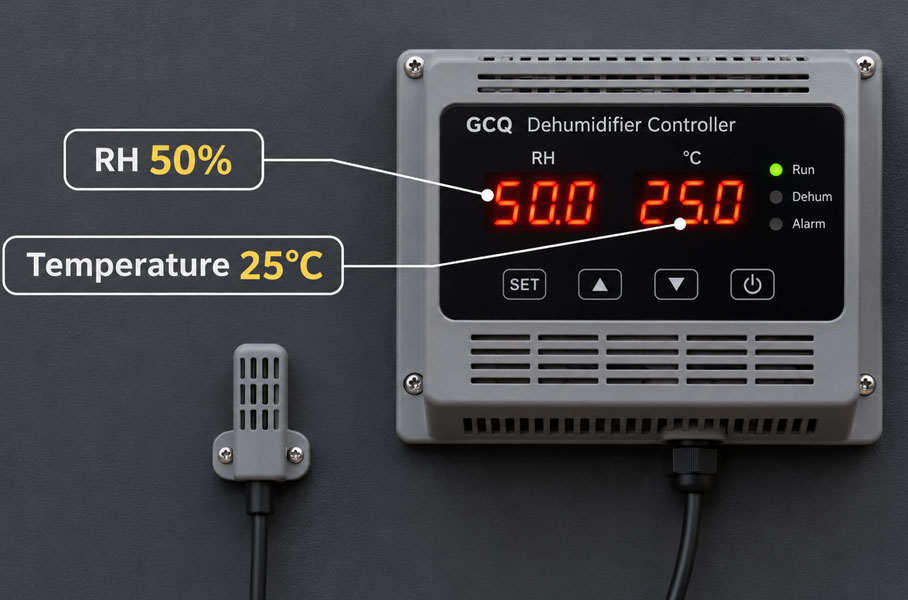
What Is Relative Humidity? Definition, Formula & Table
Relative humidity is the most quoted number in every humidity conversation, and the least understood.
The standard answer to “what is relative humidity” is correct but incomplete: it is the amount of water vapour in the air, expressed as a percentage of the most the air could hold at that temperature. The problem is the phrase “at that temperature”.
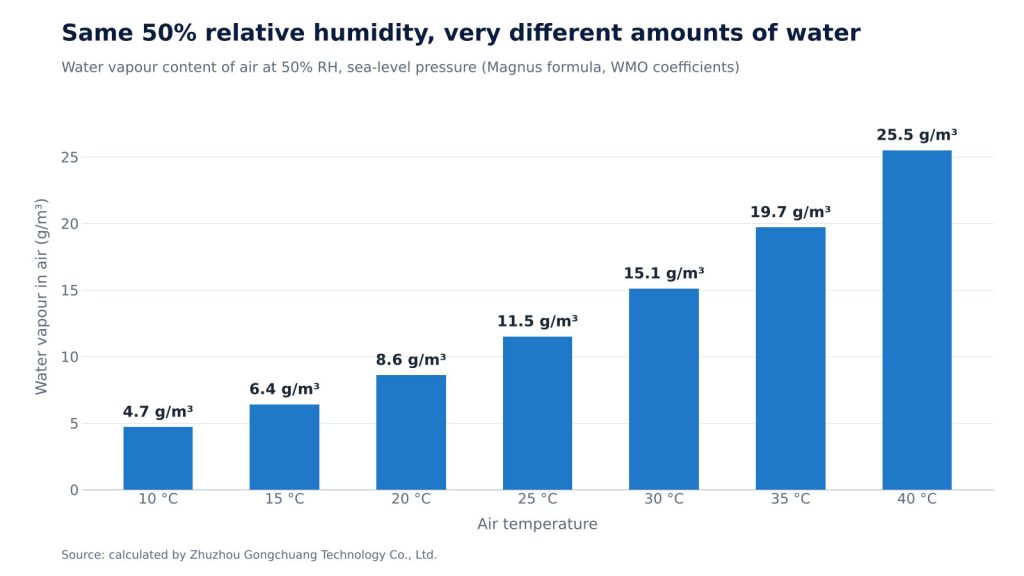
That maximum is not a constant. Near room temperature it nearly doubles for every 10°C of warming. So 50% RH at 20°C is 8.6 grams of water per cubic metre, while 50% RH at 35°C is 19.7 grams. Same number, 2.3 times the water.
That single fact explains most of the confusion that follows: why heating a room “dries” it without removing any water, why a cold window fogs in a room that reads 50%, and why a dehumidifier sized from a relative humidity target can underperform. This guide is written by the engineering team at Zhuzhou Gongchuang Technology, an industrial dehumidifier manufacturer whose controllers measure humidity inside thousands of electrical cabinets.
Key Takeaways
- Relative humidity is a ratio of vapour pressures, not a measure of how much water the air holds.
- At 50% RH, air holds 4.7 g/m³ at 10°C but 25.5 g/m³ at 40°C.
- Heating lowers RH without removing a single gram of water.
- RH is the right number for condensation, mould and comfort; dew point or absolute humidity is the right number for sizing a dehumidifier.
- A reading without its temperature, location and calibration date is not reliable enough for engineering decisions.
What Is Relative Humidity? The Definition, Stated Precisely
Relative humidity is the ratio of the actual water vapour pressure in the air to the saturation vapour pressure at the same temperature, expressed as a percentage: RH = e / es × 100%.
That is the complete answer to what is relative humidity, and three points follow from it:
- The numerator is a partial pressure, not a mass or a “water content”.
- The denominator is the saturation pressure at the same temperature. Change the temperature and the denominator changes.
- It is a ratio, so it has no physical unit. “50% humidity” on its own does not describe a quantity of water.
What Is “Relative” to Humidity?
People sometimes search the question “what is relative to humidity?” The answer is temperature. Relative humidity is relative to the most water vapour the air could hold at its current temperature. That is why the same air can read 80% in the early morning and 45% in the afternoon without any water being added or removed.
What Is the Difference Between Humidity and Relative Humidity?
If you have ever wondered what is humidity and relative humidity, and whether they are the same thing, the short answer is no. “Humidity” is a family of measures. Relative humidity is only one of them, and it is the only one that moves whenever the temperature moves.
| Term | Definition | Unit | Changes with temperature alone? |
|---|---|---|---|
| Relative humidity (RH) | Vapour pressure ÷ saturation vapour pressure × 100 | % | Yes, strongly |
| Absolute humidity (AH) | Mass of water vapour per volume of air | g/m³ | Only slightly, as air expands or contracts |
| Dew point (Td) | Temperature at which the air would start to condense | °C | No |
| Humidity ratio (mixing ratio) | Mass of water vapour per mass of dry air | g/kg | No |
| Enthalpy | Total heat content of the moist air | kJ/kg | Yes |
So what is the difference between humidity and relative humidity in practice? Absolute humidity tells you how much water is in the air; relative humidity tells you how close that air is to condensing. They answer different questions, and confusing them is the root of most humidity mistakes.
Relative humidity is the one humidity measure that moves whenever the temperature moves. That is what makes it hard to use, and also what makes it useful.
The Denominator Moves: One Number, Seven Amounts of Water
| Temperature | Water at saturation | Water at 50% RH | Dew point at 50% RH |
|---|---|---|---|
| 10°C | 9.4 g/m³ | 4.7 g/m³ | 0.0°C |
| 15°C | 12.8 g/m³ | 6.4 g/m³ | 4.7°C |
| 20°C | 17.2 g/m³ | 8.6 g/m³ | 9.3°C |
| 25°C | 23.0 g/m³ | 11.5 g/m³ | 13.9°C |
| 30°C | 30.3 g/m³ | 15.1 g/m³ | 18.4°C |
| 35°C | 39.5 g/m³ | 19.7 g/m³ | 23.0°C |
| 40°C | 51.0 g/m³ | 25.5 g/m³ | 27.6°C |
| Calculated with the Magnus formula (WMO coefficients) over a plane water surface. |
From 10°C to 40°C, the same 50% RH goes from 4.7 g/m³ to 25.5 g/m³ of water, 5.4 times as much, while the dew point rises from 0°C to 27.6°C. Two instruments can both read 50%, one in a cold store and one in a hot workshop, while the moisture load on a dehumidifier differs fivefold.
This table is the practical answer to what is relative humidity really measuring: distance from saturation, not quantity of water.
Relative humidity tells you how far the air is from condensing. It does not tell you how much water is there.
How Relative Humidity Is Calculated
The saturation vapour pressure over water is commonly calculated with the Magnus formula, using the coefficients recommended in the World Meteorological Organization (WMO) guide to instruments, valid from about -45°C to +60°C:
e_s(t) = 6.112 × exp( 17.62 t / (243.12 + t) ) [hPa, t in °C]
RH = e / e_s × 100%
Dew point: Td = 243.12 γ / (17.62 − γ), where γ = ln(RH/100) + 17.62 t / (243.12 + t)
A Worked Example
At 25°C: e_s = 6.112 × exp(17.62 × 25 / 268.12) = 31.6 hPa
Measured vapour pressure e = 15.8 hPa
RH = 15.8 / 31.6 × 100 = 50%
Absolute humidity = 216.7 × 15.8 / 298.15 = 11.5 g/m³
Dew point = 13.9°C
Once you can run this calculation, the question of what is relative humidity stops being abstract. The exponential is the key to every humidity effect. Near room temperature, the air’s capacity for water vapour rises by about 6% for each degree Celsius, and by a factor of roughly 1.8 for every 10°C. That is why warming air by 5°C can take 60% RH down to about 44%, while cooling a surface by a few degrees can bring it to the dew point.
Why Heating a Room Lowers RH Without Removing Water
| State | Temperature | Relative humidity | Water vapour |
|---|---|---|---|
| Start | 20°C | 60% | 10.3 g/m³ |
| Heated by 5°C | 25°C | about 44% | 10.3 g/m³ (unchanged) |
| Cooled back to 20°C | 20°C | 60% | 10.3 g/m³ |
Heating lowers relative humidity because the denominator gets bigger, not because the numerator gets smaller. Not a gram of water has left.
Heating is the right tool for freeze protection, for keeping a surface above the dew point, and for short-term protection while equipment is idle. It is the wrong tool for a room or cabinet that keeps taking in water: the water stays inside and returns as condensation when the heat stops or the power fails. Our substation cabinet moisture removal plan shows what that looks like in the field.
What Relative Humidity Is Good For, and What It Is Not
| Use | Is RH the right measure? | Why |
|---|---|---|
| Predicting condensation | Yes, with surface temperature | RH and air temperature give the dew point; compare it with the coldest surface |
| Mould risk | Yes | Mould responds to humidity at the surface |
| Human comfort | Yes | Evaporative cooling of the skin depends on it |
| Static electricity | Yes | Surface resistance of many materials varies with RH |
| Atmospheric corrosion of metals | Mostly | Corrosion accelerates above a critical RH |
| Sizing a dehumidifier | No | The load is a mass of water; use absolute humidity or dew point |
| Comparing sites at different temperatures | No | Equal RH can mean very different amounts of water |
| Judging whether air is "dry" | No | A cold room at 50% can hold less water than a warm room at 30% |
RH tells you whether something will go wrong. Dew point tells you how much water you have to remove.
RH Thresholds by Application: Same Number, Different Verdict
| Application | Key threshold | Basis |
|---|---|---|
| Human comfort | Upper limit about 60% RH at 25°C | ASHRAE Standard 55 sets an upper humidity ratio of 0.012 kg/kg (dew point about 16.8°C) and no lower limit; "30–60%" is common practice, not the standard's wording |
| Mould in buildings | Below 60%, ideally 30–50% | US EPA guidance; mould growth is driven by surface humidity, often cited around 80%, so cold surfaces can grow mould while the room reads lower |
| Carbon steel corrosion | Rises sharply above roughly 60–75% RH | Critical relative humidity for atmospheric corrosion; chlorides and sulphur dioxide lower the threshold |
| Electronics and ESD | Often held around 40–60% in practice | ANSI/ESD S20.20 does not require humidity control; ESD items are qualified to work at low humidity |
| Pharmaceutical production | Set per product and process | Hygroscopic powders and tablets often need low, tightly held RH; see pharmaceutical plants |
| Lithium battery dry rooms | Dew point -40°C or lower | RH is below 1% and no longer useful; dew point is the control variable; see lithium battery workshops |
| Food processing | Set per zone and product | Condensation and microbial control; see food plant dehumidification |
| Cold storage of fruit and vegetables | 85–95% RH | High humidity limits moisture loss; the goal is the opposite of "keep it dry" |
The point of the table is not any single value. It is that no universal “best humidity” exists. 60% RH is acceptable for mould control, close to the danger zone for bare steel, and unthinkable in a lithium dry room. Every “ideal humidity” claim needs a second question: ideal for what?
Three Common Misreadings, Corrected
- “ASHRAE 55 sets a 30–60% comfort zone.” It sets an upper humidity ratio limit and no lower limit.
- “ESD standards require 30–60% RH.” ANSI/ESD S20.20 does not require humidity control.
- “Below 60% RH there is no condensation.” Condensation depends on surface temperature. A cold enough surface condenses water at any room RH.
Why Your Relative Humidity Reading Is Probably Wrong
| Source of error | Mechanism | Typical effect |
|---|---|---|
| Placement | Near a heat source the sensor reads low; near a cold wall or door seal it reads high | At 25°C and 50% RH, a 2°C difference shifts the reading by about 6 points; a few degrees can mean 10–20 points |
| Response time | Polymer sensors lag behind fast temperature changes | Readings trail reality for minutes after a door opens |
| Drift and contamination | Dust, oil mist and corrosive gases settle on the sensing film | Slow drift, faster in dirty or chemical environments |
| Recovery after condensation | A saturated sensor takes time to dry out | Readings stay high after a wet event |
| Datasheet accuracy misread | ±2%" applies at the reference temperature, on a calibrated sensor | Full-range and long-term error is larger |
| RH recorded without temperature | RH cannot be converted to dew point | Condensation risk cannot be judged |

Three Things to Do About It
- Record temperature with every RH reading. Without it, you cannot calculate the dew point or judge condensation risk.
- Place the sensor near the surface you are protecting, not at the top of the cabinet or in the return air. In our cabinet installations, the sensor sits 0.2–0.4 m from the dehumidifier’s air inlet, low in the enclosure.
- Check calibration regularly with saturated salt solutions. At 25°C, lithium chloride holds 11.3% RH, magnesium chloride 32.8% and sodium chloride 75.3%.
A humidity number without a location, a temperature and a calibration date is not a measurement. It is an opinion.
Relative Humidity vs Dew Point: Which Should You Control?
| Aspect | Relative humidity | Dew point |
|---|---|---|
| What it is | A ratio | A temperature |
| Changes with air temperature | Strongly | No |
| Best for | Condensation on surfaces, mould, comfort, static | Equipment control, dry rooms, sizing |
| Sensor | Low cost | Dedicated sensor, or calculated from RH and temperature |
| Control stability | Disturbed by temperature swings | One stable variable |
Knowing what is humidity and relative humidity leads straight to this choice. Use RH to judge whether condensation, mould or static will occur. Use dew point to control how dry a space actually is: dry rooms, battery production and compressed air are always specified in dew point. Our guide to Dew Point Dehumidification explains how equipment reaches those targets.
The Psychrometric Picture in One Paragraph
Dry-bulb temperature, wet-bulb temperature, dew point, relative humidity and absolute humidity are different coordinates of the same state of air. Cool the air below its dew point and water comes out, which is how condensing dehumidifiers work. Cool it without reaching the dew point and you only lower its temperature. Heat it and RH falls while the water content stays the same. Real dehumidification means either cooling air below its dew point or capturing the vapour on a desiccant; neither is the same as “making the humidity number smaller”. Our overview of how dehumidifiers work covers all three routes.
Four Myths Worth Retiring
| Myth | Correction |
|---|---|
| 50% humidity means the air is half water. | It means the vapour pressure is half the saturation value. Water vapour is only a few percent of air even at 100% RH. |
| Warm air holds more water, so it is drier. | Being able to hold more is not the same as holding more; the water content may not have changed at all. |
| Below 60% RH there is no condensation. | Cold surfaces still condense; what matters is surface temperature versus dew point. |
| Lowering RH means dehumidifying. | There are many ways to lower RH. Only one of them removes water. |
Why Gongchuang
Zhuzhou Gongchuang Technology has built cabinet dehumidifiers and temperature-humidity controllers in Zhuzhou, Hunan, since 2007. Relative humidity is the number our customers quote most often, and the one that most often misleads them, so our specification work starts one step earlier.
Ask What Humidity Target Really Applies
- Cabinet dehumidifiers sized from the moisture load and dew-point target, not from an RH percentage alone
- Controllers that display temperature and humidity together, with dew-point control on T models
- Sensor placement guidance for cabinets, where a few degrees between the panel face and the door seal changes the reading by 10–20 points
- RS485 and wireless communication options, so drift or failure shows up as an alarm rather than as corrosion
Tell us the room or cabinet, the surface you are protecting and the temperature it runs at. We will tell you which humidity target actually applies, and whether RH is even the right number to control. Learn more about Gongchuang as an industrial dehumidifier manufacturer, or contact our engineers.
Frequently Asked Questions
What is relative humidity?
Relative humidity is the ratio of the actual water vapour pressure in the air to the saturation vapour pressure at the same temperature, expressed as a percentage: RH = e / es × 100%. Because the saturation value rises steeply with temperature, the same RH can mean very different amounts of water: 50% RH is about 8.6 g/m³ at 20°C but 19.7 g/m³ at 35°C.
What is the difference between humidity and relative humidity?
Humidity in the strict sense (absolute humidity) is the mass of water vapour in a volume of air, in g/m³. Relative humidity is a percentage that compares the water vapour present with the most the air could hold at its current temperature. Absolute humidity changes only when water is added or removed; relative humidity also changes whenever the temperature changes.
What does 50% relative humidity actually mean?
It means the water vapour pressure is half the saturation vapour pressure at that temperature. It does not mean the air is half water, and it is not a fixed amount of water: 50% RH is about 8.6 g/m³ at 20°C and 19.7 g/m³ at 35°C, 2.3 times as much.
Why does relative humidity drop when I heat a room?
Heating raises the saturation vapour pressure, the denominator, without changing the water present. Air at 20°C and 60% RH warmed to 25°C falls to about 44% RH, yet still holds about 10.3 g/m³ of water vapour.
Is 60% relative humidity too high?
It depends on what you are protecting. The US EPA advises keeping indoor humidity below 60% and ideally 30–50% to limit mould; carbon steel corrosion rises sharply above roughly 60–75% RH; and a lithium battery dry room needs a dew point around -40°C, far drier than any everyday RH reading.
Can relative humidity be 100%?
Yes. At 100% RH the air is saturated and the dew point equals the air temperature; any further cooling condenses water as fog, dew or droplets. Even then, water vapour is only a few percent of the air by volume.
How accurate are typical humidity sensors?
Datasheets often quote ±2–3% RH, but that applies to a calibrated sensor at the reference temperature. In use, placement, temperature gradients, slow response, contamination and recovery after condensation can make errors several times larger. A 2°C temperature difference at 25°C and 50% RH alone shifts the reading by about 6 percentage points.
References
- World Meteorological Organization, Guide to Instruments and Methods of Observation (WMO-No. 8), Magnus formula coefficients for saturation vapour pressure.
- ASHRAE Standard 55, Thermal Environmental Conditions for Human Occupancy.
- US EPA, “A Brief Guide to Mold, Moisture, and Your Home”.
- EOS/ESD Association, “Does an ESD Control Program Require Humidity Controls?”
- Greenspan, L. (1977), Humidity Fixed Points of Binary Saturated Aqueous Solutions, Journal of Research of the NBS, 81A(1).