
Semiconductor Dehumidifier: Peltier Anti-Condensation Guide
Content
Hide
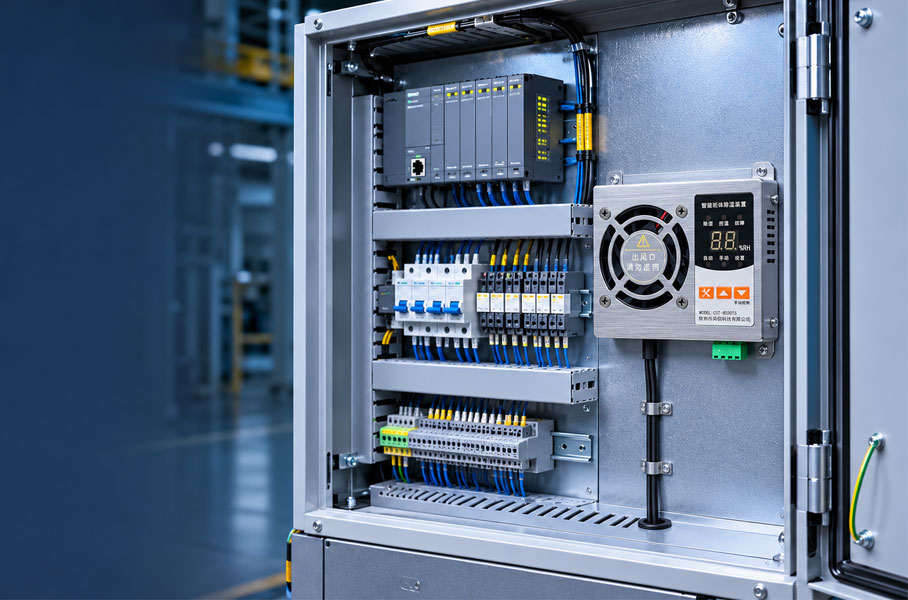
In semiconductor manufacturing, precision electronics assembly and high-reliability industrial control, humidity is not a comfort issue. It decides yield and equipment life. Inside control cabinets and equipment enclosures, where temperatures swing between day and night or between running and idle, moisture condenses on circuit boards and terminals. The result is leakage currents, corroded contacts, failed sensors and nuisance trips.
A semiconductor dehumidifier is built for exactly that space. It is not a room dehumidifier made smaller; it is a compact condensing unit designed to sit inside an enclosure, use little power and keep the air there away from its dew point. Its value is preventive: stop water vapour turning into liquid before it ever reaches a component. This guide explains how the technology works, where it fits and where it does not, how to size and install it, and what to check before you buy. It is written by the engineering team at Zhuzhou Gongchuang Technology, an industrial dehumidifier manufacturer that has built cabinet dehumidifiers in Zhuzhou, Hunan, since 2007.
Key Takeaways
- A semiconductor dehumidifier uses a thermoelectric (Peltier) module, not a compressor, to condense moisture.
- It has no refrigerant and only small fans, so it is quiet, compact and low in vibration.
- It still produces liquid water, which must drain out of the enclosure.
- It protects enclosures and equipment compartments; it does not replace cleanroom HVAC or dry-room systems.
- Size it by enclosure volume, sealing and site conditions, and read capacity at stated test conditions.
What Is a Semiconductor Dehumidifier?
The name comes from the semiconductor material in its core component, not from the industry it serves, although semiconductor fabs are among its users. In English it is often called a thermoelectric or Peltier dehumidifier.
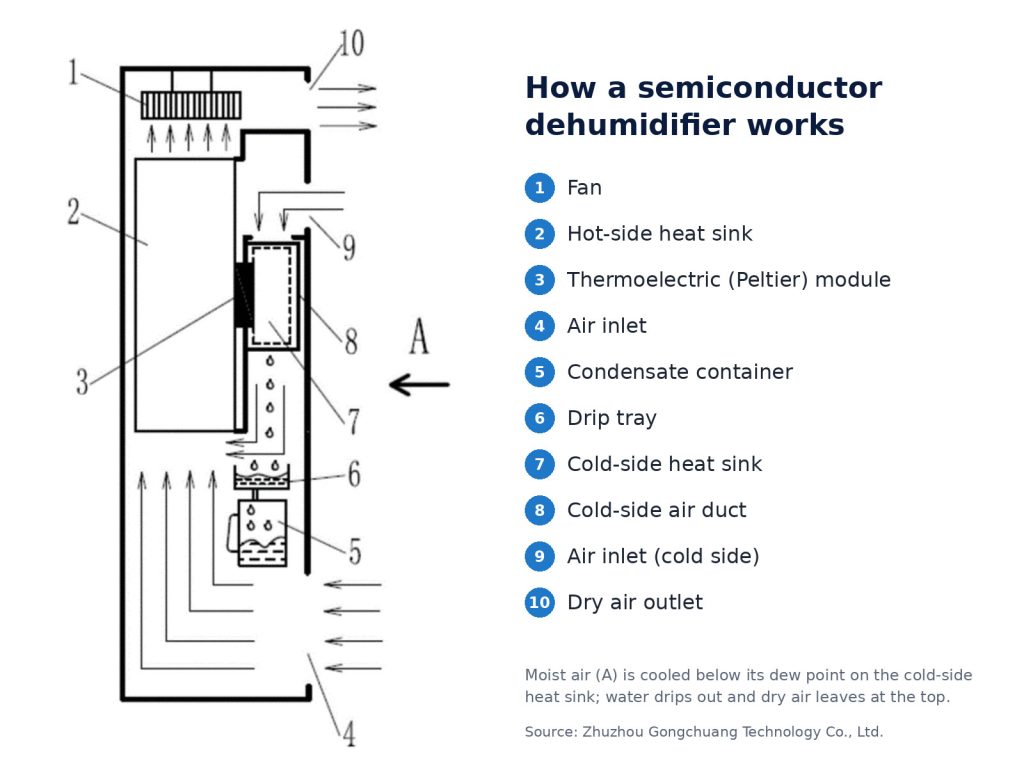
When direct current flows through a thermoelectric module, heat is pumped from one face to the other: one side becomes cold, the other hot. This is the Peltier effect. A semiconductor dehumidifier places a finned heat sink on the cold side, below the dew point of the enclosure air, so moisture condenses on it. A second heat sink on the hot side carries the heat away, and small fans move air across both. Our article on how an electrical panel dehumidifier works walks through the cycle step by step.
| Component | Role |
|---|---|
| Thermoelectric (Peltier) module | Pumps heat from the cold side to the hot side |
| Cold-side heat sink | Runs below the dew point so water vapour condenses on it |
| Hot-side heat sink or housing | Releases the pumped heat into the enclosure air |
| Fans | Move enclosure air across the cold fins and cool the hot side |
| Drip tray and drain outlet | Collect condensate and carry it out of the enclosure |
| Humidity sensor and controller | Start and stop drying at set humidity or dew-point values |
A semiconductor dehumidifier makes a cold surface below the dew point inside the enclosure, then drains the water it collects.
Why Semiconductor and Electronics Equipment Uses It
- No compressor, no refrigerant. Nothing to leak and no refrigerant handling.
- Low vibration and noise. The only moving parts are small fans, which matters next to inspection optics and sensitive instruments.
- Compact. Small units fit inside crowded control cabinets and equipment compartments.
- Low power. Typically tens of watts rather than hundreds.
- No consumables. Unlike desiccant bags, nothing saturates and needs replacing.
- Electromagnetic compatibility can be tested. Gongchuang’s GCH series, for example, has a TÜV SÜD attestation against the EMC Directive (EN IEC 55014-1 and -2); see our certifications page.
For moisture-sensitive components themselves, the reference is JEDEC/IPC J-STD-033, which defines floor life at 30°C and 60% RH or below. Keeping equipment enclosures under that humidity removes one of the routes by which moisture reaches boards and parts. For the wider fab environment, see our page on dehumidifiers for the semiconductor industry.
Where a Semiconductor Dehumidifier Fits, and Where It Does Not
| Application | Good fit? | Why |
|---|---|---|
| PLC and control cabinets in production areas | Yes | Small volume, day–night temperature swings, sensitive electronics |
| Electrical compartments of inspection and test equipment | Yes | Compact, quiet, low vibration |
| Test fixtures and burn-in or ageing chamber control boxes | Yes | Local protection where heat cycling draws in humid air |
| Outdoor equipment enclosures and battery cabinets | Yes | DC-powered models suit 12V, 24V and 48V systems |
| Conditioning a whole cleanroom | No | That is the job of the facility HVAC and makeup air system |
| Very low dew points (dry rooms, nitrogen storage) | No | A condensing unit cannot reach dew points far below 0°C; use desiccant or nitrogen |
If you need to compare technologies, our guide to condensing vs desiccant cabinet dehumidifiers explains when each one is the right tool.
Use a semiconductor dehumidifier to keep enclosures away from condensation, not to make a room bone dry.
Sizing a Semiconductor Dehumidifier
Water removal depends on power, air temperature and humidity. Always compare capacities at their stated test conditions. Examples from Gongchuang’s compact range:
| Model series | Size (mm) | Power | Rated water removal | Notes |
|---|---|---|---|---|
| JXCS-M | 86 × 71 × 51 | 10W, 15W | About 100 mL/day (15W) | Ultra-compact, built-in sensor |
| CST | 85 × 105 × 58 | 10W–30W | 200 mL/24h (30W, 30°C, 80% RH) | Optional relay output and RS485 Modbus |
| CSH | 197 × 115 × 47 | 20W–60W | 588 mL/day (60W, 35°C, 85% RH) | Ultra-thin, DIN rail mounting |
| CSEB | 180 × 110 × 62 | 20W–60W | 380 mL/24h (60W, 35°C, 85% RH) | Runs on 12V, 24V or 48V DC, or 220V AC |
| Gongchuang product data. Capacities are measured at different test conditions, so compare like with like. |
As a starting point from our selection guide, 20W suits enclosures of about 0.3 m³ or less, 30W about 0.5 m³, 40W about 1 m³ and 60W about 1.5 m³, assuming a reasonably well-sealed enclosure. Choose the next size up when in doubt, and if a 60W unit is rated below 350 mL a day, step up one power level. Fix leaks before increasing power: a semiconductor dehumidifier cannot keep up with an enclosure that keeps drawing in humid air.
Output also falls as conditions get cooler or drier. The same 60W thermoelectric unit rated at 588 mL/day at 35°C and 85% RH removes about 140 mL/day at 39°C and 40% RH. Running cost is small in absolute terms; our article on dehumidifier energy usage shows how to estimate it.
Control: Humidity or Dew Point
Most units start drying above an upper humidity limit and stop at a lower one. Models with dew-point control calculate the dew point from temperature and humidity and start drying before any surface can reach it, which is more reliable when temperatures swing. At 25°C and 65% RH, for example, the dew point is about 18°C: any surface colder than that will collect water. Bring the same air down to 40% RH and the dew point falls to about 10.5°C, so far fewer surfaces are cold enough to condense. Our guides to relative humidity and dew point dehumidification explain why.

Installation Tips
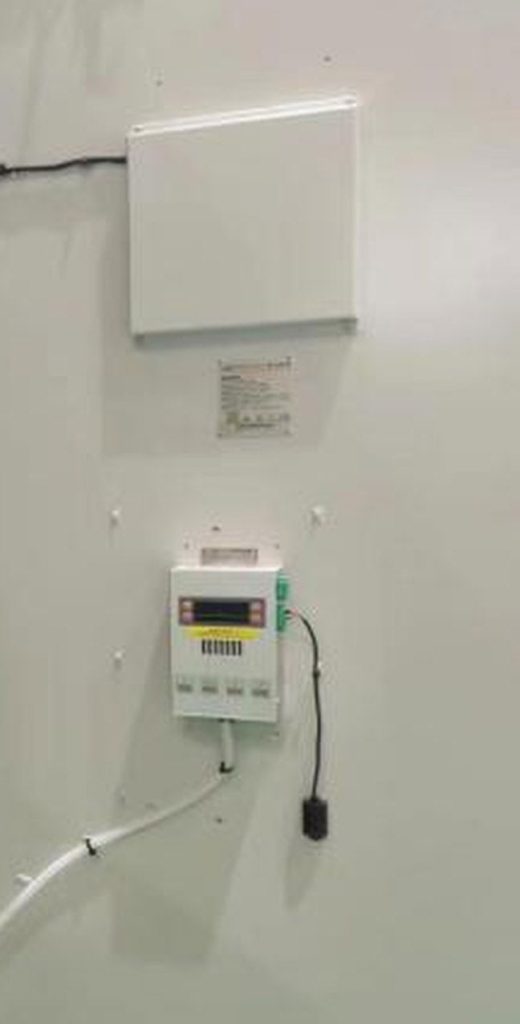
- Mount it upright in the lower part of the enclosure; condensate drains by gravity.
- Route the drain hose downward out of the enclosure, with no loops or traps.
- Keep inlet and outlet clear of cable bundles and heat sources, and leave space above the outlet.
- Place the sensor where condensation is most likely, low in the enclosure near the air inlet, not next to a hot component.
- Seal the enclosure: cable glands, door gaskets and unused openings.
What to Check Before You Buy
A datasheet number alone is not enough to judge a semiconductor dehumidifier. Ask for, or look for:
| Check | Why it matters |
|---|---|
| Water removal with its test temperature and RH | A figure without conditions cannot be compared |
| Dimensions and mounting drawing | Confirms it fits the enclosure and mounting method (screws, bracket or DIN rail) |
| Clear product photos of the heat sinks, drain outlet and terminals | Shows build quality and how the unit will be wired and drained |
| Supply voltage options | DC models avoid an extra power supply in DC cabinets |
| Control outputs and communication | Heater or alarm outputs and RS485 let the unit report faults |
| Test reports for safety and EMC | Proof rather than claims for equipment builders |
Where Semiconductor Dehumidifiers Are Heading
As domestic semiconductor equipment and electronics production grow, demand is rising for moisture protection that is compact, reliable and easy to integrate. Expect continued gains in thermoelectric module efficiency, smarter dew-point control, and remote monitoring over RS485 or wireless links, so a unit that fails or runs longer than expected raises an alarm instead of being discovered after a fault. For background on the main dehumidification technologies, see how dehumidifiers work.
Frequently Asked Questions
What is a semiconductor dehumidifier?
A semiconductor dehumidifier is a small condensing dehumidifier that uses a thermoelectric (Peltier) module instead of a compressor. Current through the module makes one side cold and the other hot; moisture condenses on the cold side and drains out of the enclosure. It is built for control cabinets and equipment enclosures rather than rooms.
Does a semiconductor dehumidifier need a drain?
Yes, in most designs. It turns water vapour into liquid water, which has to leave the enclosure through a drain hose. Some models atomise the condensate instead, but the water still has to go somewhere; it does not disappear.
How much water can a small semiconductor dehumidifier remove?
It depends on power and conditions. As examples from Gongchuang’s range, a 15W unit is rated at about 100 mL per day and a 60W ultra-thin unit at 588 mL per day at 35°C and 85% RH. Output falls in cooler or drier air.
Is a semiconductor dehumidifier suitable for a cleanroom?
It is suited to enclosures inside or around a cleanroom, such as control cabinets, equipment electrical compartments and test fixtures, not to conditioning the cleanroom itself, which is the job of the facility’s HVAC system. It has no compressor or refrigerant and only small fans, which keeps vibration and noise low.
Can a semiconductor dehumidifier reach very low humidity?
No. It removes water by cooling a surface below the dew point, so it cannot reach the very low dew points of a lithium dry room or nitrogen-purged storage. Its job is to keep an enclosure safely away from condensation, not to make it bone dry.
Choose a Semiconductor Dehumidifier for Your Enclosure
- Compact units from 10W, with AC and 12V, 24V or 48V DC options
- Ultra-thin DIN rail models and DC cabinet models for crowded panels
- Smart switchgear units with dew-point control on T models
- Relay, heater and alarm outputs, and RS485 Modbus communication on selected models
- OEM and private-label supply for equipment builders
Send us the enclosure size, supply voltage and site conditions, and we will recommend a model. Browse our products, learn more about Gongchuang as an industrial dehumidifier manufacturer, or contact our engineers.