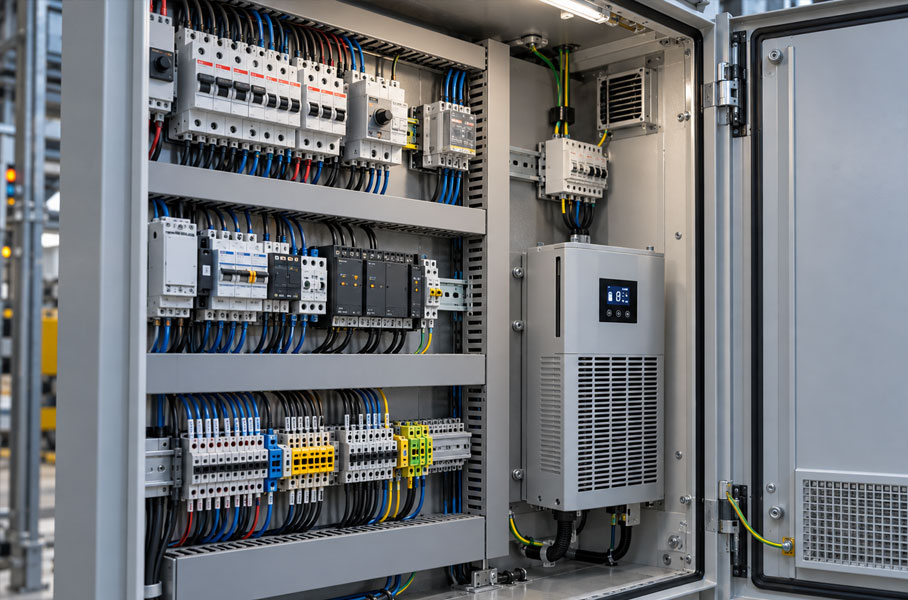
Distribution panels and switchboards are packed with components that do not tolerate moisture. In rainy seasons, basement switch rooms, coastal sites and poorly ventilated enclosures, humid air settles inside the panel. Condensation then weakens insulation, corrodes terminals and busbars, and can lead to short circuits or earth leakage. An electrical panel dehumidifier is a small device that removes that water before it causes trouble.
This guide explains exactly how a thermoelectric unit works: what happens inside it, where the heat and water go, how it decides when to run, and how to install it so it performs as designed. It is written by the engineering team at Gongchuang, an industrial dehumidifier manufacturer whose cabinet units have run on China’s power grids for more than ten years.
Key Takeaways
A thermoelectric electrical panel dehumidifier cools a heat sink below the dew point so moisture condenses on it, then drains the water out of the panel.
It uses no desiccant or refrigerant, so there are no consumables to replace.
The hot side releases heat inside the panel, which slightly warms the air and further lowers relative humidity.
Control logic, mounting height and panel sealing matter as much as the unit itself.
Why Electrical Panels Need Dehumidification
Panels are rarely airtight. Humid air enters through door gaps, cable entries and ventilation openings. At night or after rain, the steel enclosure and cable glands cool faster than the air inside. When air touches a surface below its dew point, water condenses. Repeated wet and dry cycles leave films of moisture and dust that reduce insulation resistance, oxidise terminals and eventually cause faults. Condensation in electrical panels is therefore a reliability problem, not just a cosmetic one.
Inside a Thermoelectric Panel Dehumidifier
Most compact units use the Peltier effect: when current flows through a thermoelectric module, one face becomes cold and the other hot. A thermoelectric dehumidifier builds everything else around that module.
Component
What it does
Thermoelectric (Peltier) module
Creates the temperature difference: one side cold, one side hot
Cold-side heat sink
Fins below the dew point where water vapour condenses
Hot-side heat sink
Releases the module's heat into the panel air; on some designs the whole housing does this job
Fans
Pull air across the cold fins and push heat off the hot side
Drip tray and drain hose
Collect condensate and carry it out of the panel
Temperature and humidity sensor
Measures conditions so the controller knows when to run
Controller and display
Runs the start and stop logic, shows readings and fault codes
How It Works, Step by Step
Sense. The sensor measures temperature and humidity inside the panel, and the controller decides whether drying is needed.
Cool. Current flows through the Peltier module, making one side cold and the other side hot.
Draw air in. Fans pull humid air from the lower part of the panel across the cold-side heat sink.
Condense. The cold fins are below the air’s dew point, so water vapour turns into droplets.
Drain. Droplets run into a small drip tray and flow out of the panel through the drain hose.
Return dry air. Drier, slightly warmer air leaves from the top of the unit and circulates back through the panel.
Because the process is purely physical, a Peltier dehumidifier needs no chemical drying agent and runs continuously and automatically.
Where the Heat Goes
A common misunderstanding is that the heat is expelled outside the panel. In a unit mounted inside the enclosure, the hot side releases its heat into the panel air. That is useful: warmer air has a lower relative humidity, so the unit dries the air in two ways at once, by removing water and by gently raising the temperature.
Where the Water Goes
Well-designed units drain condensate continuously through a hose rather than storing it in a tank, so nobody has to empty them. The hose must slope downward all the way to the outlet, with no traps or long flat runs, or water will back up.
How the Controller Decides When to Run
Relative Humidity Control
The simplest logic uses two thresholds: start drying when humidity rises above about 60% RH and stop when it falls to about 45% RH. This works in many panels, but relative humidity changes with temperature, so the unit can run when it is not needed or stay idle while a cold surface is wet.
Dew-Point Control
A more precise electrical panel dehumidifier calculates the dew point and compares it with the coldest surface temperature. If that surface sits at 23°C, for example, the unit can start at a 21°C dew point and stop at 19°C. It acts before condensation forms and rests the rest of the time, which saves energy and extends component life.
Outputs and Communication
Many units also offer a dry-contact output that can switch a low-temperature heater, a high-temperature exhaust fan or a fault alarm, plus RS485 communication so the panel’s monitoring system can read status and change settings remotely.
What Affects Performance
Output depends heavily on conditions. A 60W thermoelectric dehumidifier rated at 588 mL/24h at 35°C and 85% RH removes about 140 mL/24h at 39°C and 40% RH. In other words, the unit works hardest when the air is warm and humid, which is exactly when panels are most at risk. Thermoelectric units are less effective in cold conditions, and larger enclosures of 5–10 m³ are better served by compressor models.
Installation and Airflow
The best unit will underperform if it is mounted badly. Follow these rules:
Height: mount the unit in the lower-middle part of the panel, about 0.7–1 m above the floor, with at least 20 cm between the air inlet and the floor.
Airflow: use a bottom-inlet, top-outlet path and keep at least 10 cm of clearance above the outlet, so dry air can circulate to the top of the panel.
Sensor: place it 0.2–0.4 m from the air inlet, where it reads the moist lower air rather than the dry outlet stream.
Heat sources: keep the unit away from the direct exhaust of transformers, drives and other hot components.
Sealing: seal cable entries and check door gaskets. In a leaky panel, the electrical panel dehumidifier is fighting outdoor air and cannot keep up.
Dehumidifier or Heater?
Anti-condensation heaters only warm the air. They lower relative humidity, but the water stays inside the panel and can condense again once the heater stops. A thermoelectric unit actually removes the water and drains it away, which is why it is the better choice in persistently humid locations.
Frequently Asked Questions
Does an electrical panel dehumidifier need its water emptied?
Not if it has a drain hose. Condensate flows out of the panel continuously, so there is no tank to empty. The hose only needs a periodic check for kinks or blockages.
Does a Peltier dehumidifier heat up the panel?
Slightly. The hot side releases heat inside the enclosure, which raises the air temperature a little. That extra warmth further lowers relative humidity and is normally harmless for switchgear.
At what humidity should a panel dehumidifier switch on?
A common humidity setting is to start at about 60% RH and stop at about 45% RH. Dew-point control is more precise: the unit starts when the dew point approaches the temperature of the coldest surface in the panel.
Where should an electrical panel dehumidifier be mounted?
Mount it in the lower-middle part of the panel, about 0.7–1 m above the floor, with at least 20 cm between the air inlet and the floor, at least 10 cm of clearance above the outlet, and away from heat-producing components.
Choose the Right Unit for Your Panels
Gongchuang builds thermoelectric and compressor dehumidifiers for distribution panels, switchgear and energy storage cabinets, with dew-point control and optional RS485. Send us your panel size and site conditions for a recommendation, or learn more about us as an industrial dehumidifier manufacturer.