Cannabis Dehumidifiers: Room-by-Room Humidity Guide
Ask what humidity a cannabis facility should run at and you will get an answer that is true for one room and wrong for four others.
A vegetative room wants air that stays moist, because the plants are transpiring large volumes of water and dry air stalls them. A flower room wants the opposite, tightening week by week as the colas fill in. A dry room wants cool, slow, moderate air: cold enough to protect terpenes, dry enough to stop mould. A cure room holds one of the narrowest bands of all, because that is where the final water activity is set and the product becomes either shelf-stable or a microbial failure.
Five rooms. Five different jobs. And in many facilities, one specification for cannabis dehumidifiers gets copied from room to room.
This guide covers the sequence: what each room actually needs, why water activity rather than relative humidity is the number regulators and buyers judge you on, why the room sensor is not the bud, how to choose cannabis dehumidifiers room by room, how all of it ties back to microbial testing, and finally the sixth room nobody plans: the one with the electronics in it. It is written by the engineering team at Zhuzhou Gongchuang Technology, an industrial dehumidifier manufacturer that builds anti-condensation units for electrical enclosures.
Key Takeaways
- Cannabis dehumidifiers have to deliver a sequence of room targets, not a single setpoint.
- RH is what you control; water activity is what you are judged on. ASTM D8197 recommends 0.55–0.65 aw for stored dried flower.
- A room sensor reading 55% RH does not prove the inside of a dense cola is safe.
- Refrigerant units suit warm grow rooms; cool drying rooms often need desiccant or hybrid equipment.
- The control panels that run each room are a single point of failure and need their own moisture protection.
The Short Answer: Cannabis Humidity Is a Sequence, Not a Setpoint
Each room in a licensed facility pulls humidity in a different direction, so cannabis dehumidifiers that win one room often lose the next.
| Room | What it wants | Where it conflicts |
|---|---|---|
| Propagation and vegetative | Higher humidity, commonly 60–70% RH | The exact opposite of late flower |
| Flower | Stepping down, commonly 40–50% RH | Equipment must hold two different targets mid-cycle |
| Late flower | The lowest target in the building, about 45% RH or lower | The strictest stage and the main disease window |
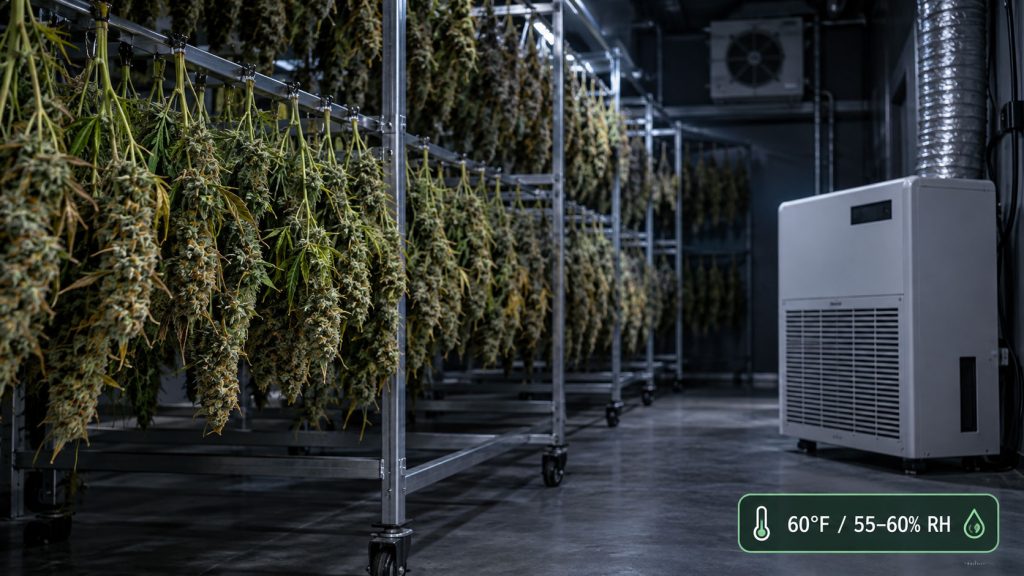
| Drying | Cool and moderate, about 60°F and 55–60% RH | Low temperature cuts refrigerant dehumidifier capacity |
| Curing | A narrow, steady band, commonly 58–62% RH | Smallest tolerance; drift shows up directly in water activity |
| Trim, packaging and storage | Stable, with no moisture pick-up | Where water activity is finally verified |
| Typical commercial ranges. Cultivar, lighting and local regulations shift these targets. |
Five rooms need five sets of targets, and most facilities copy one specification five times.
RH Is What You Control; Water Activity Is What You Are Judged On
Relative humidity describes the air. Water activity describes the product. Only one of them appears on a certificate of analysis.
| Measure | What it is | Target | Who cares |
|---|---|---|---|
| Relative humidity (RH) | Moisture in the room air, the variable your equipment adjusts | Different for every room | Cultivation and operations |
| Water activity (aw) | Water inside the flower that is available to microorganisms | 0.55–0.65 aw (ASTM D8197) | Regulators, QA and buyers |
ASTM D8197 sets the upper limit below 0.65 aw to guard against mould and the lower limit above 0.55 aw to prevent the flower becoming brittle and breaking in handling. Regulators enforce the same line: California, for example, treats dried flower as passing water activity testing only if it does not exceed 0.65 aw.
A room can hit its RH target while the product still fails. The water left inside the flower is not a direct function of today’s room reading; it is the accumulated result of drying rate, drying uniformity and cure time. You adjust the room, but you sell the water activity. That is the real job of cannabis dehumidifiers: not to hit a room number, but to deliver flower that lands inside the water activity band.
RH is a process variable. Water activity is a release variable. Treat aw as the KPI and you know how far drying really has to go.
The Five Rooms and Their Targets
| Room | RH target | Temperature | Key constraint |
|---|---|---|---|
| Propagation and vegetative | 60–70% | Commonly 72–78°F (22–26°C) | Heavy transpiration; air that is too dry slows growth |
| Early and mid flower | 40–50% | Commonly 72–78°F | Tighten steadily to keep moisture out of developing colas |
| Late flower | About 45% or lower | Similar, often cooler at night | Disease window; the stage that cannot fail |
| Drying | 55–60% | About 60–65°F (15–18°C) | Cool and moderate air means refrigerant capacity drops |
| Curing | 58–62% | About 60–70°F | Narrowest tolerance; sets final water activity |
| Trim, packaging and storage | Stable | Controlled room temperature | Product must not regain moisture |
| Typical commercial ranges compiled from industry guidance; confirm targets against your own cultivar trials and licence conditions. |
Three points matter when reading the table. First, late flower is the stage that cannot fail, because warm canopies and dense colas create the conditions grey mould needs. Second, the goal in drying and curing is not “drier” but “steadier”, which is why a dehumidifier for drying cannabis is specified for stability rather than peak capacity: drying too fast traps chlorophyll and leaves a hay-like flavour, while drying too slowly invites mould. Third, most operators move flower from drying to curing when stems snap rather than bend, or when moisture content falls to roughly 10–12%.
The grow room’s problem is “not too dry”, late flower’s problem is “not too wet”, and the dry room’s problem is “not too fast”. Three problems; one machine will not solve them.
The Room Sensor Is Not the Bud
General plant pathology guidance links grey mould (Botrytis cinerea) to very high humidity and free water on plant surfaces. Pacific Northwest extension guidance for hemp and cannabis notes that cool temperatures between 50 and 80°F, with 68°F optimal, together with high humidity and free water, favour infection.
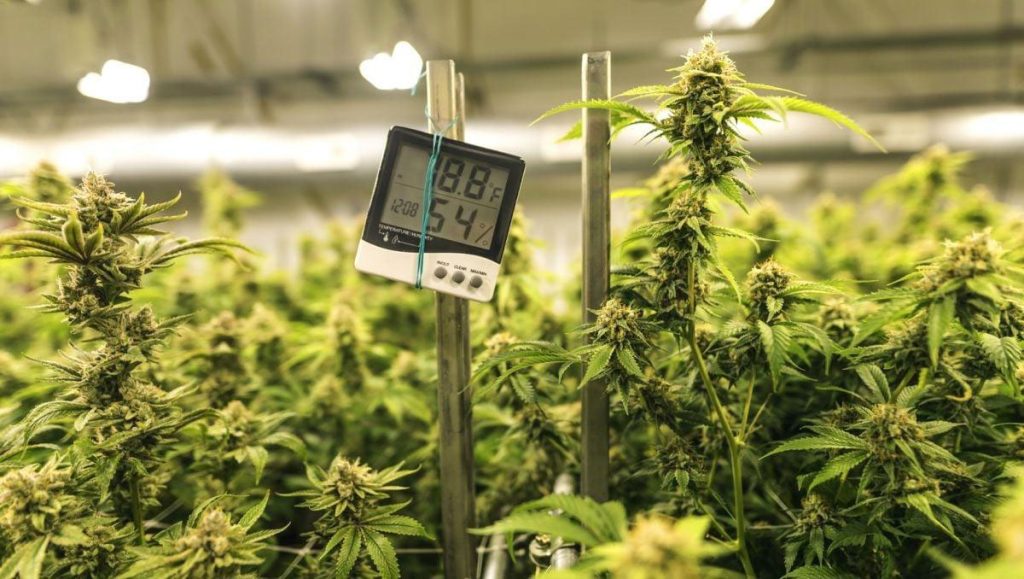
The trap is that a wall-mounted sensor reads the air between plants. A large, dense cola holds its own microclimate: warmer and wetter inside than the room reading suggests. Cannabis researchers have shown that bud rot development in greenhouse cannabis is influenced by vapour pressure deficit (Mahmoud et al., 2023), and greenhouse trials at Simon Fraser University found peak infection in a consistent window of the flowering phase, around days 33–41 (Buirs, 2024).
That leads to three practical conclusions:
- A room reading of 55% RH is not a release criterion. The inside of the bud may already be well above it.
- Very low VPD is a warning sign. When VPD falls toward 0.3 kPa or lower, the air is close to saturation and bud and leaf surfaces stay damp.
- Airflow through the canopy matters as much as dehumidifier capacity. A 2024 review of cannabis pathogen management cites 0.5–1.0 m/s of air movement as an optimal target for microbial suppression. Cannabis dehumidifiers lower the room reading; only airflow carries that dry air into the bud.
Two limits deserve honesty. Once bud rot is established in a cola, it cannot be cured; growers remove the infected material well beyond the visible lesion and take it out of the room. And biological controls are not free of trade-offs: producers are cautious about them because live organisms applied late in flower could raise microbial counts in the harvested product.
Why "Keep It at 50%" Is Not a Specification
“Keep the room at 50%” sounds precise. It leaves three questions unanswered.
- Vapour pressure deficit. The same 50% RH means different drying force at different temperatures. At 24°C, 50% RH gives a VPD of about 1.5 kPa; at 18°C, the same 50% RH gives only about 1.0 kPa. VPD expresses temperature and humidity together.
- Surface wetness. Air can be within target while leaves and buds stay wet for hours after irrigation or a lights-off temperature drop. Disease follows wet surfaces, not average air readings.
- Dew-point margin. How far can the temperature fall before a surface reaches the dew point? At 25°C and 90% RH, a drop of only about 1.8°C reaches it. At 25°C and 55% RH, the margin is nearly 10°C.
A usable specification reads more like this: “Late flower holds RH at or below 45% with a minimum VPD target, and no surface may reach the dew point during the lights-off transition.” Our guide to dew point dehumidification explains why dew point is the more reliable control signal, and why cannabis dehumidifiers benefit from controls that read dew point rather than RH alone.
“Keep it at 50%” is a wish. “At what temperature, at what VPD and with what dew-point margin” is a specification.
Choosing Cannabis Dehumidifiers by Room, Not by Brand
Room-level cannabis dehumidifiers fall into two main families. Refrigerant (compressor) units cool air below its dew point on a coil. Desiccant (rotor) units adsorb water onto a turning wheel that is regenerated with heated air. Which one wins depends on the room’s temperature and target.
| Room | Conditions | Usually suits | Why |
|---|---|---|---|
| Vegetative and early flower | Warm and humid | Refrigerant | Removes the most water per kWh in warm, moist air |
| Late flower | Warm, low RH target | Refrigerant, or desiccant support for the lowest targets | Refrigerant capacity falls as the target RH drops |
| Drying | About 60–65°F | Desiccant or hybrid | Refrigerant coils lose capacity and can frost in cool air |
| Curing | Cool, narrow band | Desiccant, or precision refrigerant with reheat | Needs stability more than maximum water removal |
| Seasonal or mixed use | Variable | Hybrid | Balances energy use and capability |
The Dehumidifier for Drying Cannabis
The drying room is where most equipment mistakes happen. A dehumidifier for drying cannabis has to work at about 60°F, which is exactly where compressor units lose capacity and their coils start to ice. The same unit that performed well in a 78°F flower room can struggle once it is moved into the dry room. When you specify a dehumidifier, cannabis drying conditions, not the grow-room datasheet, should set the rating point. Most dehumidifier cannabis drying complaints come down to that mismatch: racks near the unit over-dry while the far corners stay wet.
A dehumidifier drying cannabis also has to remove water steadily rather than as fast as possible. The first day or two after harvest release the most moisture; after that, the load falls sharply. Equipment that can modulate down without overshooting holds the slow, even dry that protects terpenes and keeps water activity on target.
Two Facts Specific to Cannabis Facilities
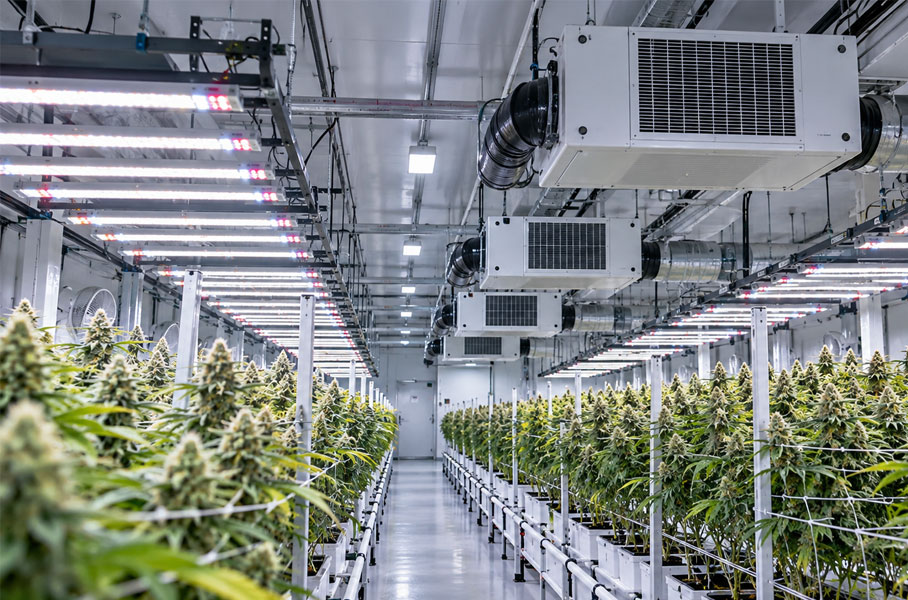
- The load is mostly latent. HVAC engineers report that plant transpiration can return about 70% of irrigation water to the air, and that the sensible heat ratio in many grow rooms falls below 0.50. Conventional DX and chilled-water equipment works best at an SHR of about 0.80 or higher, which is why grow rooms usually need dedicated dehumidification.
- Size by peak moisture load, not floor area. Add transpiration, infiltration and process water, then add a safety margin. Modular units also give redundancy, because a crop cycle cannot be paused while equipment is repaired.
Choosing a dehumidifier is not choosing a brand. It is choosing for that room’s temperature and target; change the room and the answer changes.
The Compliance Layer: Humidity Control Is How You Pass Microbial Testing
The causal chain runs in one direction: drying and curing conditions set final water activity; water activity sets how much water microorganisms can use; that shows up as yeast and mould counts and mycotoxins; and those decide whether a batch is released or destroyed. Cannabis dehumidifiers are a control point in the quality system, not just an equipment purchase.
| Example reference | What it sets |
|---|---|
| ASTM D8197 | Recommended water activity for stored dried cannabis flower: 0.55–0.65 aw |
| California (4 CCR §15717) | Dried flower passes water activity testing at no more than 0.65 aw |
| Dutch Office of Medicinal Cannabis product specification (example) | TAMC ≤ 10² CFU/g, TYMC ≤ 10¹ CFU/g; aflatoxin B1 ≤ 2 µg/kg, total aflatoxins ≤ 4 µg/kg; loss on drying ≤ 10% |
| European Pharmacopoeia 5.1.4 and 5.1.8; USP <61>, <62> and <1111> | Microbial acceptance criteria that vary by product type and route, such as inhaled versus oral |
Limits vary widely. Microbial and mycotoxin limits depend on the jurisdiction, the product form and the pharmacopoeia that applies. A batch that passes in one market can fail in another. Always check the current regulations of your target market and your customers’ audit requirements; this guide only explains the link between humidity control and release testing.
Medicinal producers working under GMP and GACP also need records. Temperature, humidity and water activity data form part of the evidence trail that auditors and buyers review. Our page on certifications and test attestations shows how we document our own products.
A dehumidifier will not make you pass testing, but it decides whether you deserve to be tested.
Legality and Licensing: What This Guide Assumes
This guide is written for licensed commercial cultivation and processing facilities. In jurisdictions where cannabis is legal for medical or adult use, growing, processing and selling it are subject to licensing and regulatory control. Requirements for facilities, GMP or GACP, and testing differ significantly between jurisdictions. Nothing here is legal advice; confirm your licence scope and local requirements before selecting cannabis dehumidifiers or any other equipment.
The Sixth Room: The One With the Electronics
Most planning for cannabis dehumidifiers stops at the grow rooms. Yet the most expensive condensation event in a cannabis facility often does not happen in a grow room. It happens in the electrical room and the control panels.
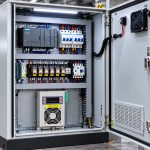
Cannabis facilities are a harsh electrical environment. The load is mostly latent, humidity is held around the clock, lighting and climate equipment draw large amounts of power, the fertigation room is a wet area by design, and growing media add dust to the moisture. The faults look electrical: random resets, controllers dropping offline, communication errors. Troubleshooting heads in the wrong direction, and when a panel must be powered down for inspection, the crop keeps growing. Live work in a damp panel also carries shock risk, which lengthens the outage further.
| Panel | Why it is at risk |
|---|---|
| Lighting controllers and driver cabinets | High power and heat; heat cycling against humid room air is a classic cause of condensation |
| Fertigation and irrigation controllers | Installed in a wet area with splashes and vapour |
| HVAC and environmental controller cabinets | If this panel fails, the room's humidity control fails with it, and the problem amplifies itself |
| Main distribution boards and MCCs | Heavy HVAC loads; rooms often adjoin wet areas |
| Conveyor, trimming and packaging control boxes | Low-mounted and close to washdown surfaces |
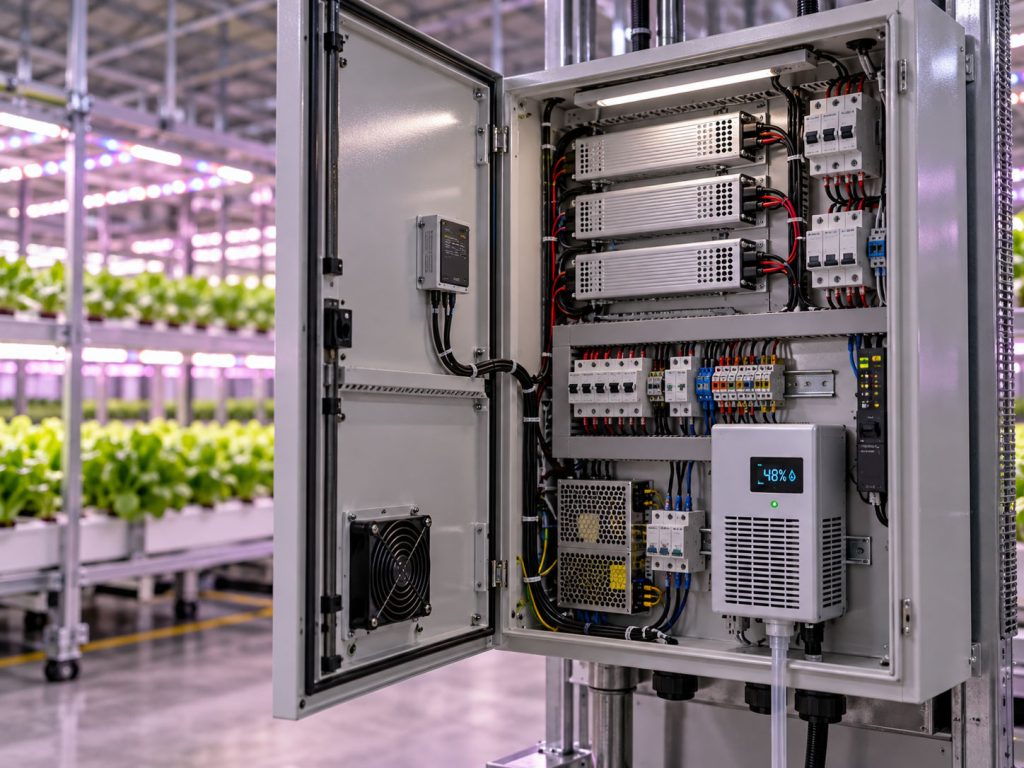
The grow room decides how good the crop is. The electrical room decides whether this crop survives at all, and it is usually the room nobody planned.
Why Sealed Panels Still Fill With Water
An IP66 or NEMA 4X rating does not mean moisture cannot get in. Those ratings test against water forced in from outside. They do not stop an enclosure from breathing in humid air as it heats and cools.
| Mechanism | What happens |
|---|---|
| Heat cycling (the main cause) | Components warm the enclosure; after shutdown or lights-off it cools, creating negative pressure that draws humid air in through cable glands, ageing gaskets and conduit |
| Pressure differences | Changing room pressure pushes or pulls moist air into the panel |
| Human factors | Humid air enters each time a door is opened for maintenance; seals are not always restored |
Drilling drain holes or adding unapproved openings is not a fix: it voids the enclosure’s IP or NEMA rating and can create warranty and compliance problems. Instead, choose a method that removes water.
| Method | When it fits |
|---|---|
| Cabinet dehumidifier | Removes water from the enclosure and drains it out; size by enclosure volume and air exchange |
| Compressed-air enclosure purge | Where instrument air is available to supply dry air continuously |
| Vortex cooler | Where the panel also needs cooling and slight positive pressure |
| Heater or lamp alone | Raises temperature but leaves the water inside; moisture returns when power is off |
For a closer look at the mechanism, see how an electrical panel dehumidifier works. The same two-layer thinking, process targets plus protected panels, applies in washdown plants too; our guide to Food Plant Dehumidification covers zone targets and panel protection in food production.
The goal is to take the water out, not to hide it. A heater only hides it in warmer air.
Specifying It: The Checklist for a Cannabis Facility
Process layer
- Set RH and temperature targets for each room, not one number for the whole site.
- Size by peak moisture load: transpiration, infiltration and process water, plus a safety margin.
- Confirm the actual temperature at the equipment, and rate any dehumidifier for drying cannabis at the dry room’s real conditions, not the datasheet’s.
- Decide whether the room also needs temperature control or very low dew points.
- Plan redundancy and modular capacity, because crop cycles cannot be interrupted, and a dehumidifier drying cannabis cannot simply be switched off mid-batch.
Electrical layer
- Record enclosure volume, air exchange and ambient temperature and humidity.
- Check whether instrument air is available and whether the panel also needs cooling.
- Plan the drain path: where will the removed water go?
- Match IP rating and materials to the cleaning regime.
After commissioning
- Inspect door gaskets and cable glands on a schedule; they are the main air paths.
- Check filters and drain lines; failures usually start there, not in the unit.
- Log temperature, humidity and water activity as evidence for audits and batch release.
- Never drill drain holes in rated enclosures.
Most dehumidification failures are blocked filters, blocked drains and worn seals, not broken units. The checklist matters more than the model number.
Why Zhuzhou Gongchuang Technology: Protecting the Room That Protects the Crop
Room-level cannabis dehumidifiers are part of a facility engineering project. What we build is the layer that keeps it running: protection for the enclosures, motor control centres and controllers that sit inside the wettest, most electrically stressed rooms in a cannabis facility.
Anti-Condensation Dehumidifiers for Grow Facility Panels
Zhuzhou Gongchuang Technology Co., Ltd. manufactures anti-condensation dehumidifiers for electrical enclosures:
- CSEB DC cabinet dehumidifiers with 12 V, 24 V, 48 V and 220 V options for lighting, fertigation and HVAC controller panels
- CSH ultra-thin DIN rail units where panel space is already committed
- GC Series smart switchgear dehumidifiers for distribution boards and MCCs
- YS-8060 drain units that carry condensate out of the enclosure
In a grow facility, the controller cabinet is a single point of failure for an entire room’s climate, and for the crop inside it. Send us the enclosure dimensions, the conditions in that room and your cleaning regime, and we will size the unit and explain the drain path. Learn more about Gongchuang as an industrial dehumidifier manufacturer, or contact our engineers.
Frequently Asked Questions
What humidity should a cannabis grow room be kept at?
It depends on the stage. Common commercial targets are about 60–70% RH for vegetative growth, 40–50% RH through most of flowering and about 45% RH or lower in late flower. Relative humidity is the control variable; the release test for dried flower is water activity, commonly 0.55–0.65 aw.
What is the ideal humidity for drying cannabis?
A widely used commercial guideline is the 60/60 rule: about 60°F (15–16°C) and 55–60% RH, held steady for roughly 7–14 days until stems snap rather than bend. Drying too fast can leave a grassy, hay-like flavour; drying too slowly raises mould risk.
What is water activity and why does it matter more than RH?
Water activity (aw) measures how much water in the product is available to microorganisms, while RH describes the surrounding air. ASTM D8197 recommends 0.55–0.65 aw for stored dried cannabis flower, and California treats dried flower above 0.65 aw as failing. A room can meet its RH target while the flower still fails on water activity.
Is 50% RH safe in late flower?
Not automatically. The room sensor reads the air between plants, not the air inside a dense cola, which can stay warmer and wetter. Bud rot risk also depends on temperature, airflow and how long surfaces stay wet. Pair the RH target with a VPD target, steady airflow through the canopy and a dew-point margin that prevents any surface condensation.
Desiccant or refrigerant dehumidifier for a cannabis facility?
Choose by room. Refrigerant dehumidifiers are efficient in warm, humid grow rooms. In cool drying rooms around 60°F, or wherever very low humidity is needed, refrigerant capacity falls and coils can frost, so desiccant or hybrid systems are often the better dehumidifier for drying cannabis. Size by peak moisture load, not floor area.
Do I need dehumidification inside the electrical room and control panels?
Yes. Lighting controllers, fertigation panels, HVAC controllers and distribution boards sit in or beside the most humid rooms in the facility. Heat cycling makes sealed enclosures draw in moist air, and a failed climate controller can take a whole room’s humidity control down with it.
References
- ASTM D8197, Standard Specification for Maintaining Acceptable Water Activity (aw) Range (0.55 to 0.65) for Dry Cannabis Flower.
- California Code of Regulations, Title 4, §15717, Moisture Content and Water Activity Testing.
- Mahmoud, M., BenRejeb, I., Punja, Z. K., Buirs, L. and Jabaji, S. (2023). Understanding bud rot development, caused by Botrytis cinerea, on cannabis plants grown under greenhouse conditions. Botany, 101(7).
- Buirs, L. (2024). MSc thesis, Simon Fraser University: bud rot development and microbial management in greenhouse cannabis.
- Integrated Management of Pathogens and Microbes in Cannabis sativa L. (Cannabis) under Greenhouse Conditions (2024). Plants, 13(6), 786.
- Pacific Northwest Plant Disease Management Handbook, Hemp (Cannabis sativa): Gray Mold.
- HPAC Engineering, “Latent Loads Matter: HVAC for Cannabis Grow Facilities.”