
Food Plant Dehumidification: Zone RH Targets & Panels
Content
Hide
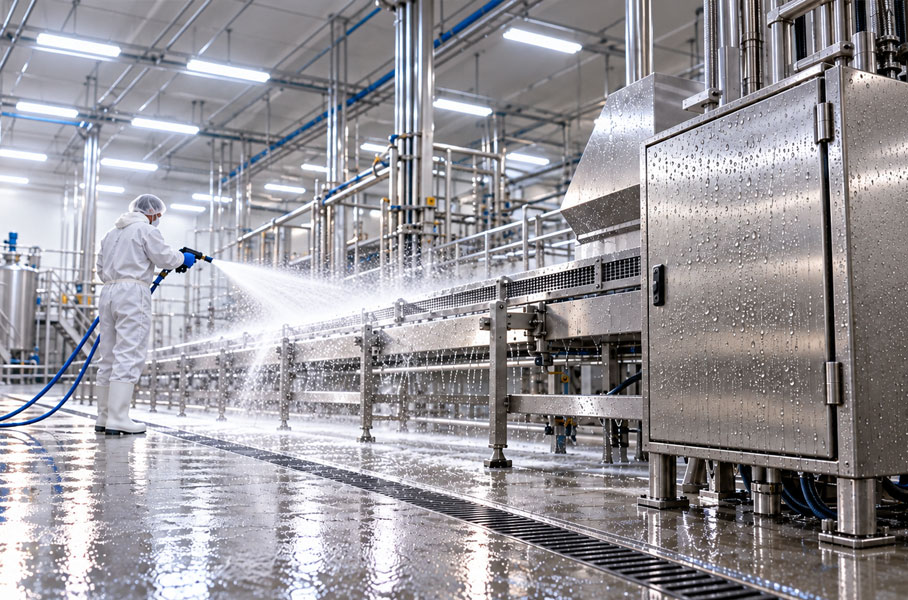
Food plants are among the hardest buildings in industry to keep dry. Production halls are washed down with high-pressure water, often with chlorinated or caustic chemicals. Chillers, freezers and cold stores sit next to warm packing halls. Some operations clean several times a day, and every cycle releases large volumes of water vapour into the air. Then the whole building runs around the clock.
That is why food plant dehumidification has to be planned on two levels — and why most facilities only plan one of them.
The first level is the room: setting a relative humidity (RH) target for each zone and choosing equipment that can hold it. The second level is much smaller and much more expensive to ignore: the inside of the control panels, motor control centres and switchgear that run the line. That is where condensation turns into intermittent faults, nuisance trips and unplanned downtime, and where the symptoms almost always look like an electrical problem rather than a moisture problem.
This guide covers both levels of food plant dehumidification: food plant humidity levels and the microbiology behind them, the regulatory status of condensation, how to choose between desiccant and refrigerant equipment, what washdown does to the specification — and why a sealed IP66 enclosure still fills with water.
The Short Answer: Food Plant Dehumidification Happens on Two Levels
Food plant dehumidification works on two levels. At room level, each zone gets an RH ceiling: about 60% in general production, 55% in cooling and aseptic packing, 50% for bakery, nuts, dried products and packing rooms, 45–50% for chocolate and confectionery, 60% in stores and 65% in wash areas. These targets keep surfaces — including the cold ones — below the moisture levels that moulds need, which cleaning alone cannot achieve.
At cabinet level, sealed IP66 and NEMA 4X enclosures still breathe: washdown heats them, cooling pulls humid air in through glands, gaskets and conduit, and the resulting film on circuit boards causes random resets and false trips. In food and beverage, an hour of unplanned downtime is commonly estimated at US$4,000–30,000. Set the target dew point first, then the temperature at the equipment, then the washdown and hygiene grade — and keep the cabinets dry so a single condensation event does not undo the rest.
| Level | Scope | Main risks | Usually owned by |
|---|---|---|---|
| 1. Room level | Production halls, packing rooms, stores, chill areas | Mould, caking, moisture pick-up, condensate dripping onto product | Facility and process engineers |
| 2. Cabinet level | Control panels, MCCs, switchgear, machine control boxes | Random resets, false trips, corrosion, line stoppages | Electrical and maintenance engineers |
Room-level dehumidification decides whether the product is right. Cabinet-level dehumidification decides whether the line keeps running — and almost nobody plans for it.
Level One: Food Plant Humidity Levels by Zone
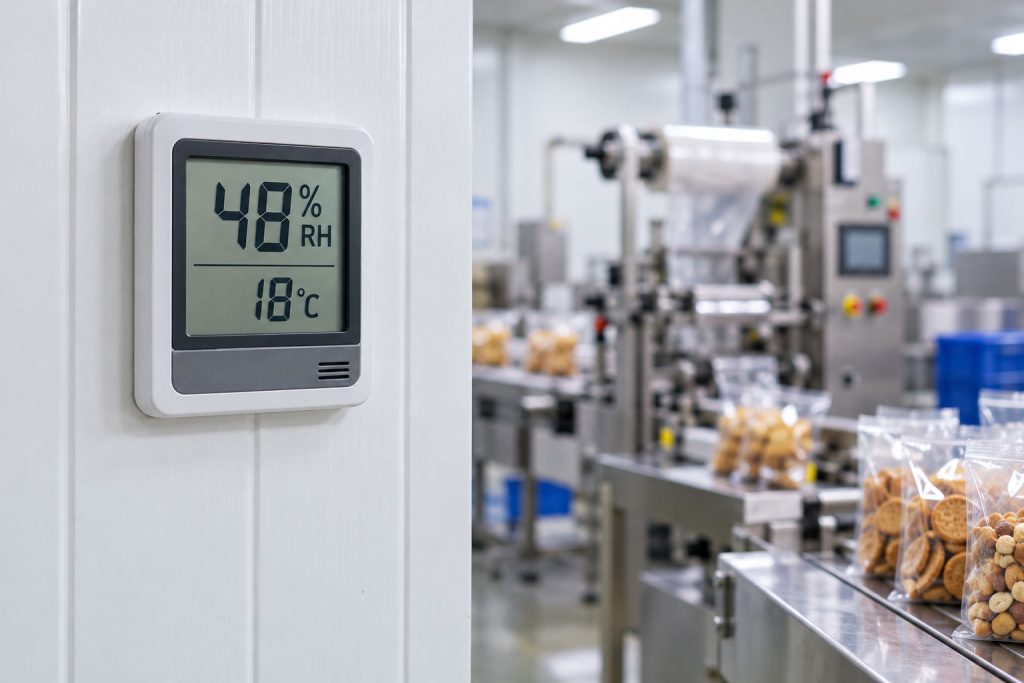
Effective food plant dehumidification starts with a number for every zone. There is no single correct figure for food factory humidity. The right target depends on how exposed the product is and how sensitive it is to moisture. The table below shows design targets widely used in food processing humidity control. Treat them as starting points to validate against your own process and your customers’ audit requirements, not as legal limits.
| Zone | Typical RH target | Why |
|---|---|---|
| General production hall | ≤ 60% | Limits airborne mould and surface growth |
| Cooling area / aseptic packing | ≤ 55% | Prevents moisture pick-up and surface mould on cooled product |
| High-risk dry products (bakery, nuts, dried foods) | ≤ 50% | Protects water activity and shelf life |
| Chocolate and confectionery | 45–50% | Prevents softening, stickiness and sugar bloom |
| Packing room | ≤ 50% | Last point of exposure — no chance to correct afterwards |
| Raw-material and finished-goods stores | ≤ 60% | Prevents caking, softening of packaging and mould |
| Wash and sanitation areas | ≤ 65% | Removes vapour and stops it spreading to clean zones |
The pattern is simple: the closer a zone is to exposed product, and the more moisture-sensitive that product is, the closer the target moves to 50%. Packing rooms are usually the strictest because the product is open for the last time there.
One caution: temperature control is not a substitute. Many spoilage organisms tolerate a wide range of temperatures, so a chilled room with high humidity is still a mould risk. Humidity in food processing plant zones has to be controlled as its own variable.
Set the number for each zone first, then choose the equipment for that number. Doing it the other way round almost guarantees the wrong machine.
Why 50–60% Is the Range That Matters: The Microbial Thresholds
The science behind these targets is water activity (aw). When a surface or a food is in equilibrium with the surrounding air, its water activity equals the air’s RH divided by 100. Microorganisms cannot grow below their minimum water activity, and the minimums are well documented:
| Organism group | Minimum water activity for growth | Equivalent equilibrium RH |
|---|---|---|
| Most spoilage bacteria | about 0.90 | about 90% |
| Most spoilage moulds | about 0.80 | about 80% |
| Xerophilic (dry-tolerant) moulds, e.g. some Aspergillus and Penicillium | about 0.65–0.70 | about 65–70% |
| Most extreme xerophilic fungi | about 0.61 | about 61% |
So why aim for 50–60% in the room when mould needs 65% or more? Because the room reading is not what the surface sees. Air that is at 55% RH near the ceiling can sit well above 70% next to a chilled wall, a cold pipe or a refrigerated display — every degree colder raises the local RH. Keeping room air at 50–60% gives the cold surfaces in the building a safety margin below the thresholds where dry-tolerant moulds begin to grow, and well below the roughly 90% at which most bacteria start to multiply.
Most food plants already supply the other ingredients moulds need: nutrients, organic dust and temperatures comfortable for people. Moisture is the one variable that can be engineered out, and that is what food plant dehumidification is really protecting against. Food factory humidity that drifts above 60% for weeks is usually visible first as mould on chilled ceilings and coolers.
Good sanitation cannot keep up with mould if humidity stays above its growth threshold. Holding RH below 60% — ideally near 50% — comes first.
Condensation Control: Food Facility Regulations
In the EU, condensation is not just a quality issue; it is written into the basic hygiene regulation. Regulation (EC) No 852/2004, Annex II, sets out structural requirements that apply directly to humidity:
| Source | What it requires |
|---|---|
| Annex II, Chapter I (general requirements for premises) | Layout, design and construction must protect against the formation of condensation or undesirable mould on surfaces. |
| Annex II, Chapter II (rooms where food is prepared or processed) | Ceilings and overhead fixtures must be constructed and finished to reduce condensation, the growth of undesirable mould and the shedding of particles. |
| Annex II, Chapter I (ventilation) | Adequate ventilation is required; mechanical airflow from a contaminated area to a clean area must be avoided; filters and parts needing cleaning must be readily accessible. |
| Codex General Principles of Food Hygiene (CXC 1-1969) | Good hygiene practices (prerequisite programmes) form the foundation; the HACCP system and its seven principles are built on top of them. |
In practice, auditors and inspectors expect condensation to be managed as part of the prerequisite programme: identified risk points, monitoring before and during production, corrective action when drips are found, and records that prove it. Without condensation control, food facility audits tend to find drips over open product first. Continuous temperature and humidity logging in the critical zones is the simplest way to show that food processing humidity control is in place rather than claimed — and it turns food plant dehumidification into documented evidence, not just a comfort measure.
Retailer-driven schemes and national rules (for example GFSI-benchmarked standards in Europe or FDA requirements in the United States) add their own wording. Always check the current text and audit checklist that applies in your market.
In regulatory terms, condensation is not an environmental nuisance. It is an auditable hygiene requirement.
Choosing a Dehumidifier for Food Processing: Desiccant vs Refrigerant
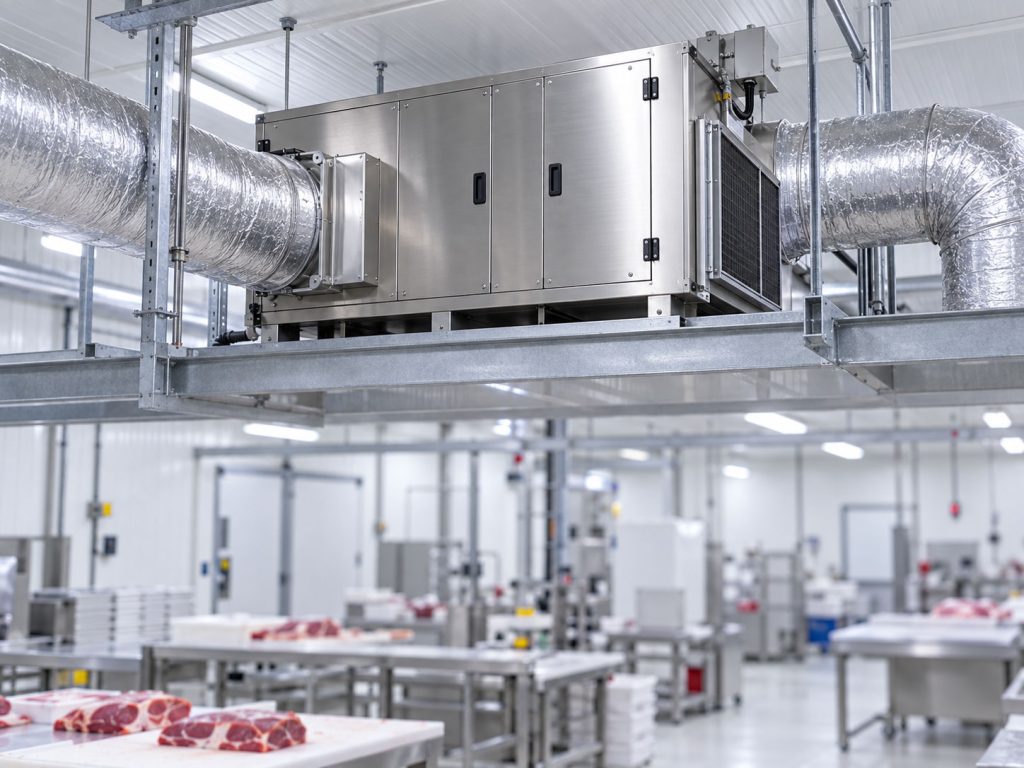
Room-level equipment for food processing humidity control comes in two main technologies, plus hybrids that combine them. Picking the wrong dehumidifier for food processing temperatures is the most common food plant dehumidification mistake.
| Technology | How it works | Strength | Weakness |
|---|---|---|---|
| Refrigerant (condensing) | Humid air passes over a cold coil; water condenses and drains away | Economical in warm, humid air | Below about 15 °C the coil starts to frost and must defrost; capacity drops sharply in cold rooms |
| Desiccant (rotor) | A silica gel or molecular-sieve rotor adsorbs moisture and is regenerated with heat | Keeps working in chilled and sub-zero spaces; reaches very low dew points | Regeneration energy; less economical than refrigerant in warm, humid conditions; adds heat to the air |
| Hybrid | Refrigerant pre-cooling followed by a desiccant stage | Handles seasonal and mixed loads | Needs a proper engineering calculation |
The selection depends on two facts that must be fixed first:
- The target dew point or RH for the zone (from the table above).
- The actual air temperature at the equipment — not the room set point on the drawing.
If the air at the unit is colder than about 15 °C, or the zone needs RH below about 40%, a desiccant system is normally the only practical answer. Chilled meat cutting rooms and curing rooms, which often run at 10–15 °C, are the classic example: a refrigerant coil frosts quickly, while a desiccant rotor keeps removing moisture. Warm, humid areas such as general packing halls in summer usually favour refrigerant units on running cost. For a deeper look at why dew point, not RH alone, should drive these decisions, see our guide to dew point dehumidification.
Target dew point first, temperature at the equipment second, energy cost third. Skip the second step and the unit will underperform.
Hygienic and Washdown Design: What Changes in the Specification
A dehumidifier for food processing areas is not an ordinary machine room unit with better seals. Wherever it sees washdown, the whole specification changes:
| Requirement | What it means in practice |
|---|---|
| Ingress protection | At least IP66 in washdown areas; IP69K where hot, high-pressure water hits the unit directly |
| Materials | 304 or 316L stainless steel; avoid galvanised steel, which corrodes under chlorinated cleaners |
| Geometry | Smooth, cleanable surfaces with no ledges, crevices or dead spaces that hold water or product |
| Internal corners | Radiused (coved) to stop dust and residue building up |
| Condensate pan | Stainless, sloped in two directions and fully draining — no standing water |
| Filtration | High-efficiency pre-filters, with HEPA stages where the zone requires them |
| Maintainability | Washdown-rated motors, sealed conduit and tool-free access panels |
| Airflow direction | From clean to less-clean areas, never the reverse |
Two points buyers often miss. First, the same RH target can require a completely different machine depending on the cleaning regime, so confirm the washdown method before discussing models. Second, if a supplier claims compliance with 3-A, EHEDG or similar hygienic-design standards, ask for the certificate or test evidence and check it against your own requirements. “Food grade” on its own is a marketing phrase, not a specification.
Level Two: The Condensation That Actually Stops Production
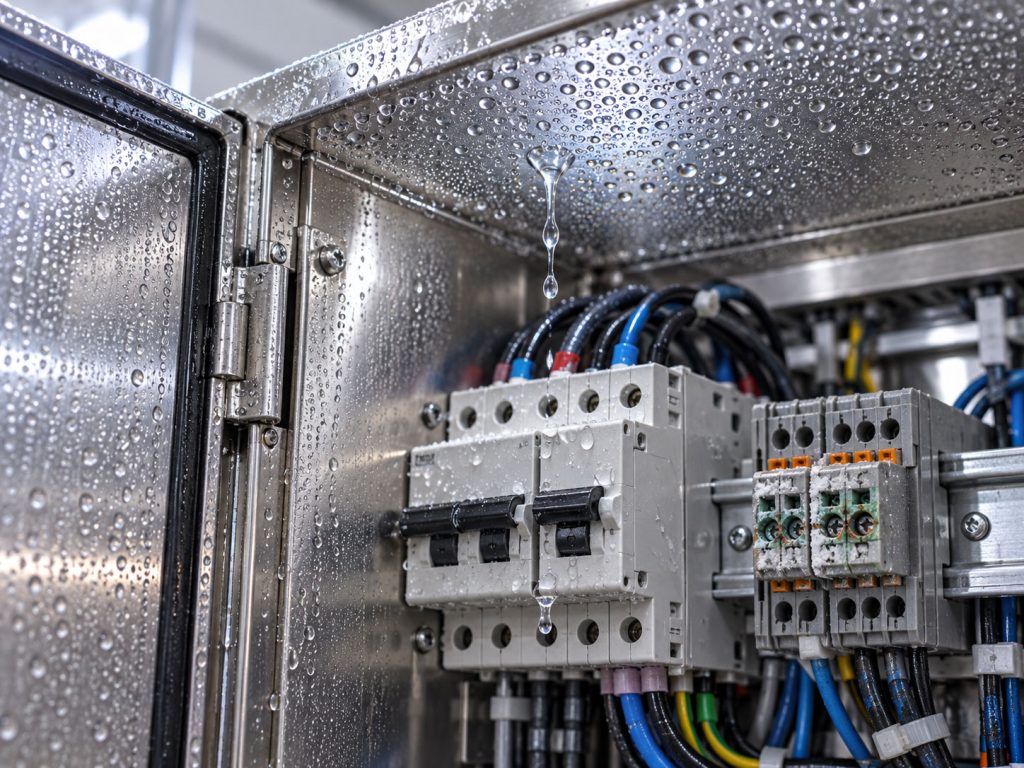
Most food plant dehumidification projects stop at the room. Yet in many food plants, the most expensive condensation event does not happen in the production hall. It happens inside a control panel — and control panel condensation, food plant maintenance logs rarely record as such.
- It is misdiagnosed. Moisture inside a cabinet produces faults that look electrical — random resets, trips, drifting signals — so troubleshooting starts in the wrong place.
- It is costly. Industry estimates put unplanned downtime in food and beverage at roughly US$4,000–30,000 per hour, and a single incident can cost up to 12 hours when cleanup is needed before restart.
- It is dangerous to inspect. Opening a wet, live panel is a shock hazard, so it must be isolated first — which lengthens the stoppage.
Food plants are a uniquely harsh environment for electrical enclosures because four stresses arrive together: frequent high-pressure washdown, aggressive chlorinated or caustic chemistry, repeated hot–cold cycling at the boundary between warm and refrigerated areas, and continuous operation. Few other industries combine all four.
Room dehumidification keeps the product compliant; cabinet dehumidification keeps the line running. The second one is rarely planned — and it usually fails first.
Why IP66 and NEMA 4X Enclosures Still Fill With Water
Many food plants assume that an IP66 or NEMA 4X rating means “sealed”. It does not mean the enclosure cannot take on moisture. Sealed enclosures breathe, and there are three routes in:
| Mechanism | What happens |
|---|---|
| Thermal cycling (the main route) | Hot washdown water heats the enclosure. As it cools, the air inside contracts and creates a slight vacuum that draws humid air in through cable glands, ageing door gaskets and conduit. |
| Mechanical | High-pressure jets force water through any poorly sealed penetration, and pressure differences keep drawing it in until they equalise. |
| Human | Every door opening lets in a full volume of humid air; seals not properly reseated after maintenance become permanent leak paths. |
Conduit deserves special attention. A conduit that runs from a warm area into a cold one becomes a condensation channel in its own right, collecting water and delivering it straight into the enclosure.
Do not drill drain holes. Drilling an enclosure or adding unapproved openings changes the tested assembly and can invalidate its IP or NEMA rating — creating both a compliance issue and a warranty issue, while letting washdown water in.
An IP rating keeps out water that is sprayed at the enclosure. It does not keep out humid air that the enclosure draws in by itself.
Control Panel Condensation: Food Plant Faults Misdiagnosed as Electrical Problems
| What you see | What is actually happening |
|---|---|
| Random resets and intermittent faults | A thin film of moisture bridges PCB tracks and lets stray current flow where it should not |
| False overcurrent or feedback trips | When the film dries it leaves conductive salts and chemical residue that distort signals and stress power stages and IGBTs |
| Faults after washdown, fine once it dries | The signature symptom of condensation inside the enclosure |
| Shortened component life | Gradual damage, not sudden failure |
| Accelerated corrosion | Cleaning chemicals react with copper and solder far faster than in ordinary humid air |
These faults are hard to trace because the damage is gradual and the symptoms are intermittent. The drive, PLC card or sensor looks unstable, so the investigation focuses on electrical parameters and replaces parts that were only the victims.
If the faults follow the washdown schedule rather than the load, the pattern itself is the diagnosis.
What Actually Works Inside a Cabinet: Options Compared
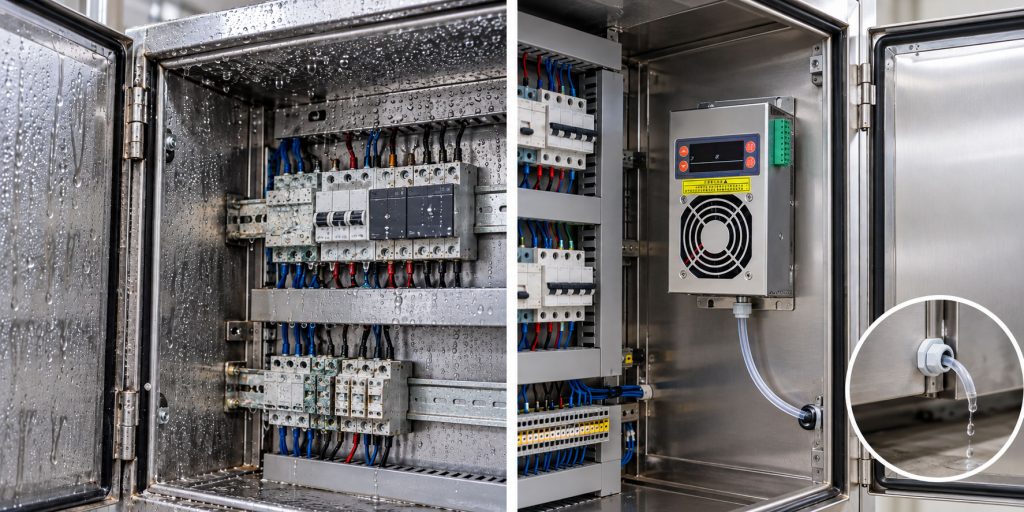
| Option | How it works | Key limitation |
|---|---|---|
| Heaters, fan heaters, lamps | Raise air temperature inside the enclosure | Do not reduce the amount of water; once switched off for washdown, moisture condenses again. Fans add a failure point and an air path |
| Compressed-air enclosure dryer | Filters and a membrane dry instrument air (dew points around −22 °C on common units) and purge the enclosure | Needs a reliable instrument-air supply and periodic filter changes; well proven in harsh washdown areas |
| Vortex cooler | Compressed air produces clean, cool air and keeps the enclosure at slight positive pressure | Needs compressed air; mainly a cooling solution that also purges |
| Cabinet dehumidifier | Condenses moisture inside the enclosure and drains it outside, lowering the actual water content | Must be sized to enclosure volume and air exchange, with a reliable drain path |
| Positive pressure with filtration | Keeps internal pressure above ambient so humid air cannot enter | Needs continuous air supply and filter maintenance |
Three questions decide between them: Is clean instrument air available at the panel? Does the enclosure also need cooling? What are its volume and likely air-exchange rate? When sizing a cabinet dehumidifier, food industry panels should be treated as high-load enclosures because washdown cycles them every shift. This type of unit is often the simplest fit for panels without an air supply, and for plants that do not want to tie panel protection to the compressed-air system.
The most common mistake is relying on heat alone. A heater lets the air hold more water; it does not remove it. When the power goes off for cleaning, that water comes back onto the circuit boards.
The goal is to take the water out, not to hide it in warmer air.
Where Food Plants Need Cabinet Protection Most
| Area | Risk point |
|---|---|
| Washdown and high-pressure cleaning zones | Repeated thermal cycling plus chemical corrosion — the worst condensation inside panels |
| Cold stores, blast freezers and their switchboards | Hot–cold boundary; conduit carries moisture in; large temperature difference across the enclosure wall |
| CIP areas | Hot, steam-laden air |
| Bakeries | Humid processes, flour dust and condensation in cooling areas |
| Meat and poultry processing | Frequent wet cleaning releasing large amounts of vapour |
| Dairy and ready-meal packing | Lowest RH targets and exposed product |
| MCC rooms and main switchrooms | One wet enclosure can stop a whole line |
| Metal detectors, conveyors and packing machine control boxes | Mounted low and close to washdown surfaces |
The panels closest to the washdown hose, closest to the cold source and lowest to the floor fail first.
Specifying and Maintaining: The Checklist
A sound food plant dehumidification plan, room and cabinet together, comes down to a short list. Use it to set food plant humidity levels before buying any dehumidifier for food processing areas.
Before specifying
- Target dew point or RH for each zone (from the zone table)
- Actual air temperature at the equipment, not the room set point
- Washdown and cleaning regime — this decides the IP rating and materials
- Enclosure volume, air-exchange rate and whether instrument air is available
- Drain route — where the removed water will go
After commissioning
- Inspect and flush condensate pans and drain lines regularly, including stainless ones
- Replace pre-filters and high-efficiency filters on schedule
- Check rotors and heat-exchange surfaces for organic dust, which combines with moisture to form biofilm
- Inspect and replace door gaskets and cable glands — ageing seals are a main air path
- Log temperature and humidity continuously in critical zones as part of condensation control, food facility records and food processing humidity control reviews; without records, there is no evidence that your condensation control actually works
- Never drill drain holes or add unapproved openings to rated enclosures
Most dehumidification failures are blocked filters, blocked drains and tired seals, not broken machines. The maintenance list matters more than the model number.
Why Zhuzhou Gongchuang Technology: Drying the Layer That Stops the Line
Room-level food plant dehumidification is a facility engineering project. What we build is the smaller, more urgent layer inside it: keeping the cabinets, motor control centres and switchgear that run your line dry, in an environment that is constantly trying to fill them with water.
As an industrial dehumidifier manufacturer in Zhuzhou, China, Zhuzhou Gongchuang Technology Co., Ltd. designs and produces anti-condensation dehumidifiers for electrical enclosures:
- CSEB thermoelectric cabinet dehumidifiers in 12 V, 24 V, 48 V and 220 V versions for control, instrumentation and power cabinets
- CSH ultra-thin DIN-rail units for panels where space is already committed
- GC series smart switchgear dehumidifiers for MCC rooms and switchrooms
- GCU-8030S mini units for small machine and distribution boxes
- YS-8060 anti-condensation drain dehumidifiers that condense moisture and drain it out of the enclosure
Every cabinet dehumidifier — food industry or otherwise — is selected from enclosure volume and air exchange, so it removes water instead of just warming the air. If your plant is losing production to faults that appear after washdown and disappear once the panel dries, that is the problem we build for. Send us the enclosure dimensions, the ambient conditions and your cleaning regime, and we will size the unit and explain the drain path.
Frequently Asked Questions
What humidity should a food plant be kept at?
Food plant humidity levels are set by zone, and good humidity in food processing plant areas follows a simple ladder: about 60% RH or lower in general production, 55% in cooling and aseptic packing, 50% for bakery, nuts and dried products and in packing rooms, 45–50% for chocolate and confectionery, 60% in stores and 65% in wash areas. The closer the zone is to exposed product, the closer the target should be to 50%.
Why is condensation a food safety issue, not just a comfort issue?
Because condensate dripping onto exposed product is a contamination route. Regulation (EC) No 852/2004, Annex II, requires premises to protect against condensation and undesirable mould on surfaces and requires ceilings and overhead fixtures to reduce condensation. Under the Codex General Principles of Food Hygiene, these hygiene practices are the foundation of a HACCP system.
Should I use a desiccant or a refrigerant dehumidifier?
Fix the target dew point first, then the actual air temperature at the equipment. Below about 15 °C, or where RH must stay below about 40%, a desiccant rotor unit is normally the only practical choice, because refrigerant coils frost and lose capacity. In warm, humid spaces, refrigerant units are cheaper to run.
Can I use a standard dehumidifier in a washdown area?
No. Washdown areas need at least IP66 (IP69K for direct hot, high-pressure jets), 304 or 316L stainless steel, smooth cleanable geometry and a fully draining condensate pan. Avoid galvanised steel. Confirm the cleaning regime before choosing a model.
Our panels are IP66 / NEMA 4X. Why is there still water inside?
Because sealed enclosures breathe. Washdown heats them, and as they cool they draw humid air in through cable glands, ageing gaskets and conduit. High-pressure jets and door openings add more. Drilling drain holes or adding unapproved openings can invalidate the enclosure rating.
What symptoms does panel condensation cause?
Random resets, intermittent faults, false overcurrent or feedback trips, drifting signals, faults that appear after washdown and clear once dry, and early component failure. Moisture films bridge PCB tracks and leave conductive residue when they dry. If faults follow washdown rather than load, condensation is the likely cause.
What is the most effective way to keep a control cabinet dry?
Remove the water rather than heating it. Heaters do not lower the water content and stop working when power is isolated for cleaning. Effective options include a cabinet dehumidifier that drains condensate outside, a compressed-air membrane purge dryer, a vortex cooler with positive pressure, or filtered positive pressure. Choose based on instrument-air availability, cooling needs and enclosure volume.