Dehumidifier Energy Usage: Watts, kWh per Litre & Bills
Content
Hide
A 50-pint dehumidifier at the ENERGY STAR minimum efficiency draws about 550 watts. That is the kind of number most shopping pages quote, and on its own it tells you almost nothing about your bill.
Watts are power: the rate at which the machine uses electricity right now. What you pay for is energy: watts multiplied by hours. And the hours are not a property of the dehumidifier. They are a property of the room: how much water is getting in, and how fast the unit can take it out.
Two identical units, one in a sealed basement and one next to a leaking bathroom, will have very different dehumidifier energy usage. The appliance is the same; the bill is not. This article separates the numbers that get confused, shows how to compare dehumidifier energy usage fairly, explains dehumidifier vs AC energy usage, and ranks the changes that actually move the bill. It is written by the engineering team at Zhuzhou Gongchuang Technology, an industrial dehumidifier manufacturer of cabinet and enclosure dehumidifiers.
Key Takeaways
- Energy (kWh) = power (W) × run hours ÷ 1,000. Run hours depend on the room’s moisture load.
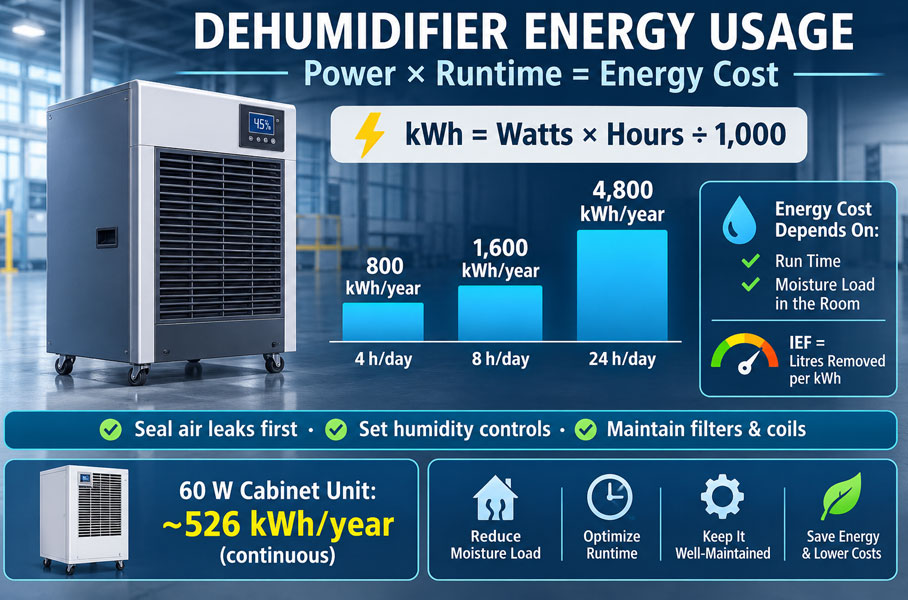
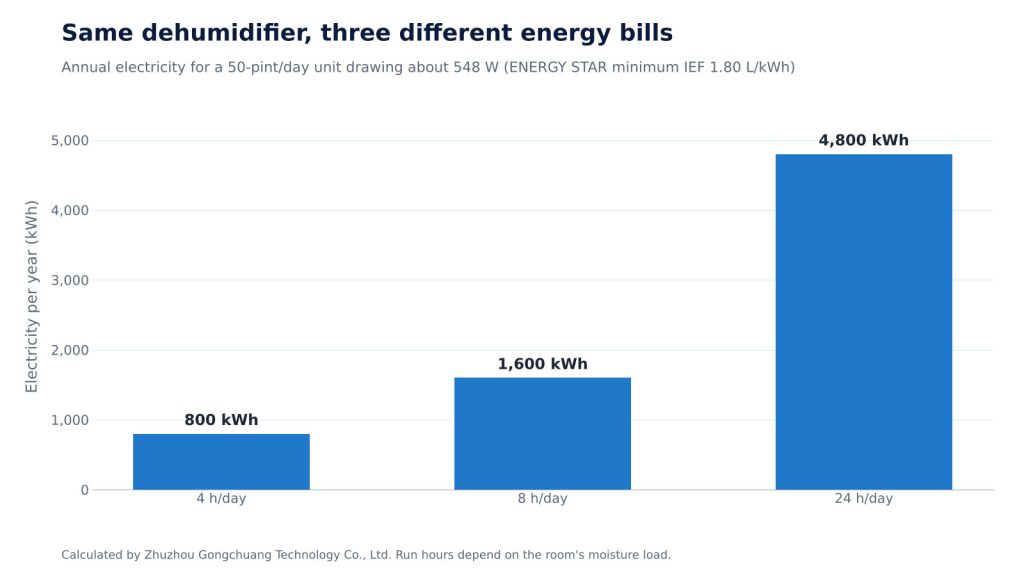
- A 50-pint unit at about 548 W uses roughly 800, 1,600 or 4,800 kWh a year at 4, 8 or 24 hours a day.
- The 0.68 kWh of latent heat per litre is not the electricity cost; compressor units use about 0.30–0.64 kWh of electricity per litre at rated conditions.
- Compare units on Integrated Energy Factor (IEF) from the same test procedure, never across technologies.
- Sealing leaks usually cuts the bill more than buying a slightly more efficient unit.
Dehumidifier Energy Usage: The Short Answer
| Concept | Unit | What it means | What decides it |
|---|---|---|---|
| Power | W | Rate of electricity use at this moment | The machine |
| Run time | h | How long it runs per day | The room's moisture load |
| Energy | kWh | W × h ÷ 1,000 | Both together |
| Cost | $ | kWh × electricity price | Your tariff |
Estimating Power From the Efficiency Rating
You can estimate a unit’s average input while dehumidifying from its capacity and its Integrated Energy Factor (IEF):
Power (W) ≈ capacity (L/day) ÷ 24 ÷ IEF (L/kWh) × 1,000 1 US pint = 0.473 L
| Capacity | IEF used | Estimated power | Electricity per litre |
|---|---|---|---|
| 20 pints/day (9.5 L) | 1.57 (ENERGY STAR minimum, ≤25 pints) | about 251 W | 0.64 kWh/L |
| 35 pints/day (16.6 L) | 1.80 (ENERGY STAR minimum, 25–50 pints) | about 383 W | 0.56 kWh/L |
| 50 pints/day (23.7 L) | 1.80 (ENERGY STAR minimum, 25–50 pints) | about 548 W | 0.56 kWh/L |
| 60 pints/day (28.4 L) | 3.30 (ENERGY STAR minimum, over 50 pints) | about 358 W | 0.30 kWh/L |
| Calculated from ENERGY STAR Version 5.0 minimum IEF values, in effect since 18 October 2019. Real models vary; check the label. |
One detail is easy to miss: because the largest portable class has a much higher efficiency threshold, a qualifying 60-pint unit can draw less power than a 50-pint unit. Capacity alone does not predict wattage.
Check the rating year. Since June 2019, US portable dehumidifiers have been rated at 65°F instead of 80°F, and the same machine now shows a lower pints-per-day figure. Never compare the wattage of a pre-2019 “70-pint” unit with a post-2019 “50-pint” unit as if the labels meant the same thing. Our article on how dehumidifiers work explains that rating change.
Watts tell you how fast it uses electricity. Hours tell you for how long. The bill is the two multiplied.
What It Costs to Run: Three Duty Cycles
| Run pattern (548 W unit) | Per day | Per month (30 days) | Per year | Cost per month at $0.18/kWh |
|---|---|---|---|---|
| 4 h/day, intermittent damp season | 2.2 kWh | 66 kWh | 800 kWh | about $12 |
| 8 h/day, typical home use | 4.4 kWh | 132 kWh | 1,600 kWh | about $24 |
| 24 h/day, continuous | 13.2 kWh | 395 kWh | 4,800 kWh | about $71 |
| $0.18/kWh is an example price. Multiply the kWh figures by your own tariff. |
The same machine can produce a sixfold difference in annual dehumidifier energy usage depending on how long it runs. Decide how long it should be running before worrying about how efficient it is.
The Heat Bill Is Not the Electricity Bill
| Number | What it is | Use it for |
|---|---|---|
| About 0.68 kWh per litre (2,450 kJ/kg) | Latent heat released when one litre of water vapour condenses | Explaining why dehumidifiers blow warm air; room heat load |
| About 0.30–0.64 kWh per litre | Electricity a compressor unit uses per litre at rated conditions (1 ÷ IEF) | Calculating running cost |
| About 1.0–1.3 kWh per litre | Total heat added to the room: latent heat plus electrical input | Sizing cooling for the space |
For dehumidifier energy usage, only the second row matters. The electricity figure can be lower than the latent heat because a compressor dehumidifier is a heat pump, not a resistance heater. It moves heat from the cold coil to the warm coil rather than generating all of it from electricity. For small units the two numbers happen to be close; for large, efficient units the electricity per litre is less than half the latent heat. Using 0.68 kWh per litre as a running cost will overstate the bill for most modern compressor units.
Latent heat is physics. Electricity use is engineering. Keep the two numbers apart.
Where the kWh Actually Goes
| Component | Role in energy use |
|---|---|
| Compressor | The largest share of input in a refrigerant dehumidifier |
| Fan | A smaller share, but low airflow cuts both water removal and efficiency |
| Controls and standby | Small, but continuous: every 1 W of standby is 8.76 kWh a year |
| Defrost (cool spaces) | Electricity used while no water is being removed |
| Desiccant regeneration | Usually the dominant energy use in desiccant units |
The fan uses a small part of the electricity, but if it fails, the rest is wasted.
How to Compare Dehumidifier Energy Usage Between Units
Anyone asking how to compare dehumidifier energy usage fairly needs one number and three rules. The number is the Integrated Energy Factor (IEF): litres of water removed per kWh, including fan and low-power modes.
| Portable capacity | US federal minimum IEF | ENERGY STAR minimum IEF |
|---|---|---|
| 25.00 pints/day or less | 1.30 L/kWh | 1.57 L/kWh |
| 25.01–50.00 pints/day | 1.60 L/kWh | 1.80 L/kWh |
| 50.01 pints/day or more | 2.80 L/kWh | 3.30 L/kWh |
| Federal minimums apply from 13 June 2019 (also adopted in Canada); ENERGY STAR Version 5.0 from 18 October 2019. Whole-home units have separate thresholds by case volume. |
- Compare like with like. Use IEF only between units tested under the same procedure and in the same product class. Desiccant units are not rated on the same basis as compressor units.
- Convert to kWh per litre. 1 ÷ IEF gives electricity per litre: 1.80 L/kWh is 0.56 kWh/L; 3.30 L/kWh is 0.30 kWh/L.
- Multiply by your load. Annual energy = litres you need to remove per year × kWh per litre. A rating cannot predict the litres; only your space can.
Remember that IEF is measured at 65°F and 60% RH. In a colder space, every compressor unit removes less water per kWh than its label suggests. That is the honest answer to how to compare dehumidifier energy usage: compare efficiency on the label, but estimate the bill from the load.
L/kWh is a ruler for comparing machines, not a crystal ball for predicting bills.
Your Bill Is Set by the Load, Not the Machine
| Moisture source | How it enters | Effect on dehumidifier energy usage |
|---|---|---|
| Infiltration | Door gaps, cable entries, ducts, building cracks | Often the largest source, and the easiest to fix |
| Internal generation | People, processes, washing, drying | Tied to activity and production |
| Materials | Timber, cardboard and building materials releasing moisture | Noticeable in new buildings and new stock |
| Ventilation | Outdoor air brought in deliberately | A major source in humid seasons |
Energy = load (litres) × specific energy (kWh per litre)
A 15% efficiency gain multiplies the second term by 0.85. Halving infiltration can halve the first term.
This is the single most important idea in dehumidifier energy usage. Efficiency is the multiplier; the load is what gets multiplied. Changing the load has more leverage. Sealing will not remove every source, since people, processes and materials still release water, but it is usually the cheapest step with the biggest return.
Dehumidifier vs AC Energy Usage
Comparing dehumidifier vs AC energy usage only makes sense once you know what each machine is for. Both use a refrigeration cycle and both remove water, but they are designed for opposite outcomes.
| Aspect | Dehumidifier | Air conditioner |
|---|---|---|
| Main job | Remove moisture | Remove heat |
| Effect on temperature | Adds heat to the room | Cools the room; heat goes outdoors |
| Moisture removal | Its purpose | A by-product of cooling |
| Typical power | A few hundred watts (about 250–550 W in the table above) | A 10,000 BTU/h room unit with an EER of 11 draws about 900 W; central systems draw several kW |
| Efficiency metric | IEF in L/kWh | EER, CEER or SEER, based on cooling output |
Because the metrics measure different outputs, there is no single “litres per kWh” comparison between them. The practical rule is about conditions:
- Cool but damp (basements, storerooms, cabinets): a dehumidifier uses less energy, and running an air conditioner would overcool the space without solving the damp.
- Hot and humid (occupied rooms in summer): the air conditioner is needed for the heat anyway; add a dehumidifier only if humidity stays high once the temperature is reached.
- Sealed electrical cabinets: a cabinet dehumidifier is far cheaper to run than an enclosure air conditioner, unless the cabinet also needs cooling.
Not “which uses less electricity” but “which job does the space need done”.
Desiccant vs Compressor: Where the Energy Curves Cross
| Conditions | Compressor | Desiccant |
|---|---|---|
| Above about 20°C, normal humidity | Most efficient choice | Usually more energy per litre, mainly for regeneration heat |
| Below about 10–15°C | Capacity falls; coils can frost | Keeps removing water steadily |
| Very low dew points | Cannot reach them | The practical option |
When comparing published figures, check whether a desiccant system’s energy is quoted as electricity, heat or both; regeneration can be supplied by gas, steam or waste heat, which changes the comparison completely. Our guide to condensing vs desiccant cabinet dehumidifiers covers the technology side.
The question is not which one uses less electricity, but which one still works at your temperature.
The Industrial Case: Cabinets and Enclosures
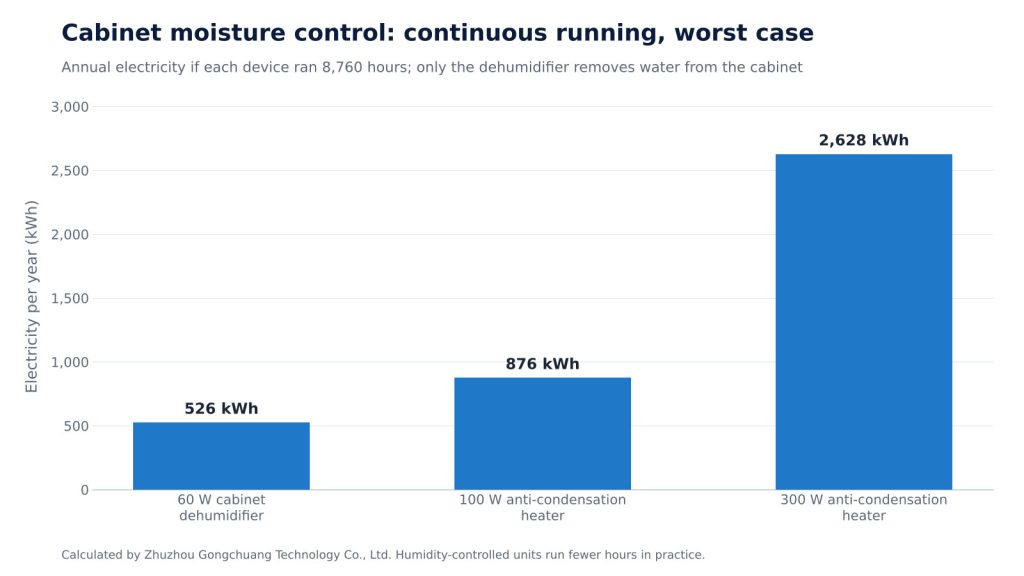
| Device | Power | Energy if running all year (8,760 h) | Cost at $0.18/kWh | Removes water? |
|---|---|---|---|---|
| Cabinet dehumidifier | 60 W | 526 kWh | about $95 | Yes |
| Anti-condensation heater | 100 W | 876 kWh | about $158 | No |
| Anti-condensation heater | 300 W | 2,628 kWh | about $473 | No |
| Worst case: continuous operation. A humidity-controlled dehumidifier normally runs far fewer hours. |
A thermoelectric cabinet unit is less efficient per litre than a large compressor dehumidifier: a 60W unit rated at 588 mL/day uses about 2.4 kWh per litre if it runs continuously. But a cabinet holds only a few grams of water vapour, so the absolute energy is small, and unlike a heater it actually takes water out. Our substation cabinet moisture removal plan shows what replacing heaters with dehumidifiers achieved at 12 sites.
For cabinets, the levers on dehumidifier energy usage rank like this: sealing and cable-entry blocking first, control settings second, equipment last.
In a cabinet, the most expensive option to run is often the “cheap” heater.
Five Ways to Cut the Bill, Ranked by Payback
| Rank | Action | Why it works | Cost |
|---|---|---|---|
| 1 | Seal gaps: door gaskets, cable entries, wall penetrations | Reduces the litres that need removing | Low |
| 2 | Set the humidity target and deadband correctly | Stops the unit once the target is reached | Very low |
| 3 | Size the unit correctly, not oversized | Avoids short cycling and unstable humidity | Medium |
| 4 | Maintain filters, coils and drains | Restores airflow and heat transfer | Low |
| 5 | Replace with a higher-efficiency unit | Lowers kWh per litre | High |
The first two cost almost nothing and cut dehumidifier energy usage most; the last costs the most, yet most people start with the last one. If you are unsure what humidity target to set, our guide to what relative humidity is explains why the right number depends on what you are protecting.
What Maintenance Does to the Number
| Problem | Result | Effect on energy |
|---|---|---|
| Dusty filter or coil | Lower airflow and poorer heat transfer | More kWh per litre |
| Frosting or failed defrost | Less time spent removing water | Longer run hours |
| Low refrigerant | Lower water removal | More kWh per litre |
| Blocked drain | Shut-offs or repeated cycling | Lower efficiency |
| Sensor drift | Starts and stops at the wrong humidity | Uncontrolled run hours |
Peak Demand, Circuits and Sizing
| Item | What to check |
|---|---|
| Starting current | A compressor's inrush current is several times its running current; size breakers and generators for it |
| Continuous load | Plan circuits for the full rated input during long runs |
| Power factor | Single-phase compressors can have a low power factor; assess it on large projects |
| Multiple units | Stagger start-up so compressors do not start together |
| Generator supply | Confirm starting headroom, or the unit may fail to start |
You pay for kWh, but you size the breaker for the first second of start-up.
Why Gongchuang
Zhuzhou Gongchuang Technology has built cabinet dehumidifiers and temperature-humidity controllers in Zhuzhou, Hunan, since 2007. Because a dehumidifier’s bill is set by run hours, we specify on the load, not just the wattage.
Estimate Your Enclosure’s Annual kWh
- Thermoelectric cabinet units from 10W to 140W, plus 7 L and 10 L compressor units for larger enclosures
- Duty cycle and annual kWh estimated for your enclosure, not just a wattage
- Adjustable start and stop humidity set points, so the unit stops instead of idling
- DC power options for battery and telecom cabinets, and RS485 or wireless communication so a unit that runs too long raises an alarm
- Sealing advice first, so equipment is not upsized to fight a leak
Send us the enclosure volume, the ambient conditions and your current approach. We will tell you what the load implies, and whether the next dollar is better spent on a machine or a door gasket. Learn more about Gongchuang as an industrial dehumidifier manufacturer, browse our cabinet dehumidifiers, or contact our engineers.
Frequently Asked Questions
How much electricity does a dehumidifier use per day?
Multiply its power by its run hours. A 50-pint/day unit at the ENERGY STAR minimum efficiency draws about 548 W, so it uses about 2.2 kWh in 4 hours, 4.4 kWh in 8 hours and 13.2 kWh in 24 hours. At an example price of $0.18 per kWh, that is about $0.39, $0.79 and $2.37 per day.
Is 0.68 kWh per litre the electricity cost of a dehumidifier?
No. About 0.68 kWh is the latent heat released when one litre of water vapour condenses. The electricity a compressor dehumidifier uses is a separate number: at the ENERGY STAR minimum ratings it ranges from about 0.64 kWh per litre for small units down to about 0.30 kWh per litre for large ones.
Does a dehumidifier use more energy than an air conditioner?
Usually less power: a portable dehumidifier typically draws a few hundred watts, while a 10,000 BTU/h room air conditioner with an EER of 11 draws about 900 W. But they do different jobs. An air conditioner removes heat and some moisture; a dehumidifier removes moisture and adds heat. In a cool, damp space a dehumidifier is the more efficient tool; in a hot, humid room an air conditioner may be needed anyway.
How do I compare dehumidifier energy usage between models?
Compare Integrated Energy Factor (IEF, in litres per kWh) for units tested under the same procedure, check that both capacities use the post-2019 US rating, convert IEF to kWh per litre, then multiply by the litres you actually need to remove. Do not compare desiccant and compressor units on the same IEF figure.
Does running a dehumidifier 24/7 cost a lot?
A 548 W unit running around the clock uses about 13.2 kWh per day, roughly 395 kWh per month, or about $71 a month at $0.18 per kWh. Most spaces do not need continuous running; a humidistat that stops the unit once the target is reached cuts the hours.
Can I reduce dehumidifier energy use without buying a new unit?
Yes. Seal the gaps where humid air enters, set a sensible humidity target with a deadband, and keep filters, coils and drains clean. Reducing the moisture load cuts run hours directly, which usually saves more than a small efficiency gain from a new unit.
Why does my dehumidifier use more power in winter?
In cool air a compressor dehumidifier removes less water per hour, and below roughly 15–18°C its coil can frost and must defrost. During defrost it uses electricity without removing water, so it runs longer for the same result.
References
- ENERGY STAR, Dehumidifiers Version 5.0 Specification (effective 18 October 2019).
- Natural Resources Canada, Dehumidifiers (portable and whole-home) energy efficiency regulations, citing the US DOE test method (10 CFR 430, Subpart B, Appendix X1).
- ENERGY STAR, “Dehumidifier Testing and Capacity” (65°F test temperature from 2019).
- Gongchuang CSH series data sheet: 588 mL/day at 60W, 35°C and 85% RH.