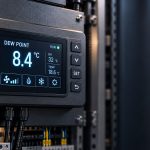

Substation Dehumidifier Guide: Efficiency and Selection
A substation is only as reliable as its driest cabinet. Switch rooms, cable interlayers, terminal boxes and outdoor switchgear are sealed or semi-sealed spaces where moisture builds up quietly. Over time, high humidity corrodes metal parts and ages insulation. Once condensation forms, it can cause surface discharge, short circuits in secondary wiring and even false tripping of protection relays. Choosing the right substation dehumidifier is therefore a core part of routine maintenance, not an optional extra.
This guide compares the main dehumidifier types, explains what really drives efficiency, and shows how to size and install a unit for switchgear and control cabinets. It draws on field experience from Gongchuang, an industrial dehumidifier manufacturer whose cabinet units have run on China’s State Grid and Southern Power Grid for more than ten years.
Key Takeaways
- Condensation depends on dew point, not relative humidity alone. A cabinet at 50% RH can still condense if a surface is at or below the dew point.
- Heaters lower relative humidity but leave the water inside the enclosure. A condensing substation dehumidifier drains it out.
- Thermoelectric units suit cabinets up to about 3 m³. Compressor units suit enclosures of 5–10 m³.
- Placement, sealing and control logic affect results as much as rated capacity.
Why Moisture Builds Up in Substation Enclosures
Humid air enters through cable entries, door gaps and ventilation louvers, especially during rainy seasons and in coastal regions. Inside the cabinet, temperatures swing between day and night. When warm, humid air meets a colder surface, such as a steel panel at dawn or a cable entry near the ground, it cools to its dew point and releases water. Poorly sealed cabinets make the problem worse because every air exchange brings in fresh moisture.
Dew Point vs Relative Humidity
Relative humidity tells you how saturated the air is at its current temperature. Dew point tells you the temperature at which that air starts to condense. At 35°C and 50% RH, for example, the dew point is about 23°C. Any surface at 23°C or colder will collect water, even though 50% RH sounds safe. This is why a controller that only starts at 60% RH can stay idle while condensation forms, and why dew point is the better signal for any switchgear dehumidifier.
Four Types of Substation Dehumidifiers
Most substation dehumidifier options fall into four groups. The first three are hardware types; the fourth is a control layer that can sit on top of them.
1. Anti-Condensation Heaters
Heaters raise the local temperature so relative humidity falls. They are cheap and simple, but they only move the problem. The water stays inside the cabinet, and when the heater switches off or the night gets colder, it can condense again. Heaters also draw power for as long as they run and offer little control over actual humidity.
2. Thermoelectric (Peltier) Dehumidifiers
A thermoelectric dehumidifier uses the Peltier effect: one side of a semiconductor module becomes cold, moisture condenses on a cold-side heat sink, and the water drains out through a hose. There is no compressor and no refrigerant, so units can be very compact. Gongchuang’s JY series is only 47 mm thick. Noise comes only from the small fans. Output depends heavily on conditions: a 60W unit rated at 588 mL/24h at 35°C and 85% RH removes about 140 mL/24h at 39°C and 40% RH. Thermoelectric units work best in warm, humid air and become less effective in cold conditions.
3. Compressor Dehumidifiers
Compressor units use a refrigeration cycle, like a small air conditioner, and remove far more water. A 10L model, for example, is rated at 10 L/24h at 35°C and 90% RH with a 220W rated power. They suit large enclosures, prefabricated cabins and containers of 5–10 m³, but they are heavier (around 20 kg) and need wall space for mounting.
4. Smart and Networked Systems
A smart substation dehumidifier combines temperature and humidity sensing, a microcontroller and switching logic. Better units add dew-point control, fault alarms and RS485 communication so operators can see status and alarms remotely instead of opening each cabinet.
| Type | How it works | Strengths | Limitations | Typical use |
|---|---|---|---|---|
| Anti-condensation heater | Warms air to lower RH | Low cost, simple | Water stays in the cabinet; continuous power draw | Mild climates, backup |
| Thermoelectric dehumidifier | Peltier cold side condenses water | Compact, no refrigerant, few moving parts | Lower capacity; weaker in cold or dry air | Switchgear, RMUs, terminal boxes up to ~3 m³ |
| Compressor dehumidifier | Refrigeration cycle | High capacity | Heavier, larger, higher power | Large enclosures and cabins, 5–10 m³ |
| Smart / networked control | Sensors plus dew-point logic and RS485 | Runs only when needed; remote alarms | Needs correct sensor placement and setup | Any of the above, especially unmanned sites |
Output figures are manufacturer ratings under the stated test conditions.
What Really Determines Dehumidifying Efficiency
Rated capacity is only part of the story. In the field, four factors decide whether a substation dehumidifier keeps cabinets dry or simply runs all day.
Control Logic: Humidity Trigger vs Dew-Point Trigger
A fixed humidity trigger forces a trade-off. Set it at 60% RH and the unit may never start while condensation forms; set it at 50% RH and it may run most of the time, wasting energy and ageing faster. Dew-point control solves both. If the coldest surface sits at about 23°C, a unit set to start drying at a 21°C dew point and stop at 19°C (a 2°C hysteresis) acts before condensation appears and rests the rest of the time.
Installation Position
Mount the substation dehumidifier about 0.7–1 m above the cabinet floor. With a bottom-inlet, top-outlet airflow design, the dry air stream can reach around 1.5 m and circulate through the whole cabinet. Place the humidity sensor 0.2–0.4 m from the air inlet, or about 40 cm above the floor. Keep at least 10 cm of clearance above the outlet and at least 20 cm between the inlet and the floor.
Enclosure Sealing
A switchgear dehumidifier in a leaky cabinet is fighting the outdoor air. Seal cable entries and check door gaskets before sizing up the unit. In large spaces such as cable trenches or cable interlayers, several distributed units with zoned control usually work better than one oversized machine.
Drainage
The drain hose must slope downward all the way from the unit to the outlet. Avoid water traps and long flat runs: standing water blocks the hose and stops air from escaping, so condensate backs up. If the unit is mounted on a cabinet door, check that the hose does not kink when the door opens and closes.
How to Size a Substation Dehumidifier
Start by estimating how much water the substation dehumidifier must remove from the enclosure air:
Moisture to remove (g) ≈ air density (about 1.2 kg/m³) × enclosure volume (m³) × humidity ratio difference (g/kg, from a psychrometric chart) × 1.1 safety factor
Example: a sealed 2 m³ switchgear cabinet at 35°C holds about 30.8 g of water per kg of dry air at 85% RH, and about 17.7 g/kg at 50% RH. Drying it once from 85% to 50% RH therefore removes roughly 1.2 × 2 × 13.1 × 1.1 ≈ 35 g of water. This figure assumes a fully sealed cabinet. Real cabinets exchange air through gaps and cable entries, so choose a unit with clear spare capacity.
As a starting point, match the enclosure volume to the unit type:
| Enclosure volume | Typical enclosure | Recommended unit | Rated output |
|---|---|---|---|
| 0.8–2.0 m³ | Terminal boxes, compact switchgear | 60W thermoelectric (JY series) | 588 mL/24h at 35°C, 85% RH |
| 2–3 m³ | Switchgear, ring main units | 120W thermoelectric (GCH series) | 1,000 mL/24h at 35°C, 85% RH |
| 5–10 m³ | Large enclosures, prefabricated cabins | 10L compressor (GCA series) | 10 L/24h at 35°C, 90% RH |
Where Substation Dehumidification Is Heading
Moisture control is becoming part of the digital substation. With RS485 communication, humidity and alarm data from each cabinet can feed the site’s condition monitoring platform alongside SF6 gas status, partial discharge and infrared temperature readings. Combined, these signals help engineers move from fixed-interval inspections to predictive maintenance. Power options matter too: units that accept both AC and DC supply fit more easily into substations with DC auxiliary systems.
Frequently Asked Questions
What is the best dehumidifier for a substation switchgear cabinet?
For switchgear cabinets up to about 3 m³, a thermoelectric condensing dehumidifier with dew-point control is usually the best fit. It removes water from the cabinet through a drain hose instead of only warming the air. Larger enclosures of 5–10 m³ are better served by a compressor dehumidifier.
Is an anti-condensation heater enough for a substation?
A heater lowers relative humidity by warming the air, but it does not remove water from the enclosure. When the heater switches off or the temperature falls, the moisture can condense again. In humid regions, a condensing switchgear dehumidifier gives more reliable protection.
What humidity level should a switchgear cabinet be kept at?
Many operators aim to keep switchgear below about 60% RH. A more reliable rule is to keep the dew point of the cabinet air below the temperature of its coldest surface, which is exactly what dew-point control is designed to do.
Where should a switchgear dehumidifier be installed?
Mount the unit about 0.7–1 m above the cabinet floor, place the humidity sensor 0.2–0.4 m from the air inlet, keep at least 10 cm of clearance above the air outlet, and route the drain hose downward without traps or long flat sections.
Need Help Choosing a Substation Dehumidifier?
Gongchuang has built cabinet dehumidifiers in Zhuzhou, China since 2007. Send us your cabinet volume, site climate and power supply, and our engineers will recommend a model and dew-point setting. Learn more about us as an industrial dehumidifier manufacturer.