
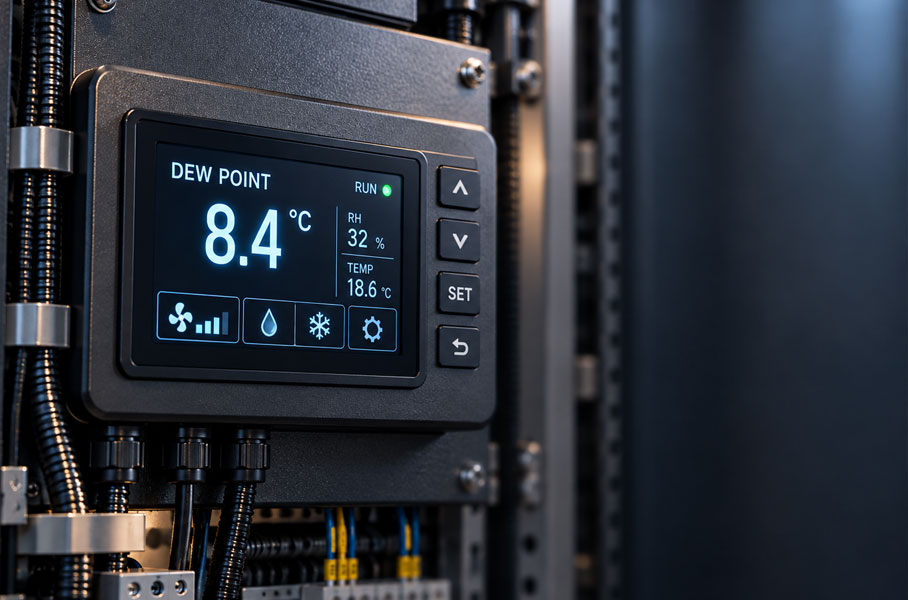
What Is Dew Point Dehumidification? Meaning & Methods
In battery plants, precision electronics, pharmaceutical storage and electrical enclosures, the term dew point dehumidification comes up again and again. It does not describe one type of machine. It describes a control approach: instead of aiming for a relative humidity (RH) figure, the system aims for a target dew point, which reflects the actual amount of water vapour in the air.
That difference matters. Relative humidity rises and falls with temperature even when the moisture content stays the same. Dew point does not. By controlling to dew point, a dehumidifier can hold moisture at a precise, repeatable level, which is why dew point dehumidification is the standard for dry rooms, low-humidity storage and condensation prevention.
Key Takeaways
- Dew point is the temperature at which air becomes saturated and water starts to condense. The lower the dew point, the drier the air.
- Dew point dehumidification controls to that temperature, so it tracks real moisture content rather than relative humidity.
- Condensing dehumidifiers work down to dew points a little above freezing. Sub-zero targets such as -40°C need desiccant rotor systems.
- Lower is not always better: every extra degree of dryness costs energy.
What Dew Point Means
Dew point is the temperature to which unsaturated air must be cooled, at constant pressure, before water vapour begins to condense into liquid. At that point the relative humidity is 100%, and the moisture content of the air is fixed.
For example, air at 25°C and 60% RH has a dew point of about 16.7°C. Cool that air to 10°C and a large share of its water vapour condenses out. This is the physical basis of every dew point dehumidification system: remove water until the remaining air can no longer condense above the target temperature.
Because each dew point corresponds to a single moisture content, it gives engineers a clear scale for dryness:
| Dew point | Water vapour (g per kg of dry air) | Typical meaning |
|---|---|---|
| 16.7°C | about 11.9 | Ordinary indoor air at 25°C and 60% RH |
| 10°C | about 7.6 | Comfortable, dry office air |
| 0°C | about 3.8 | Near the practical limit of condensing dehumidifiers |
| -20°C | about 0.63 | Low-humidity storage and processing |
| -40°C | about 0.08 | Dry rooms, roughly 150 times drier than ordinary indoor air |
| Moisture content at sea-level pressure, calculated with standard psychrometric formulas. |
Dew Point vs Relative Humidity
Relative humidity describes how close air is to saturation at its current temperature. Warm the same air and its RH falls; cool it and RH climbs, even though no water has been added or removed. A controller that switches on at a fixed RH can therefore run when the air is already dry, or stay idle while condensation forms on a cold surface.
Dew point removes that ambiguity. If the dew point of the air is below the temperature of every surface it touches, nothing can condense. That makes dew point control the more reliable choice wherever moisture damage, rather than comfort, is the concern.
How Dew Point Dehumidification Works
Condensing (Refrigerant or Thermoelectric) Dehumidifiers
These units pass air over a surface colder than the air’s dew point. Water condenses on the cold coil or heat sink and drains away. Compressor units use a refrigeration cycle; thermoelectric units use a Peltier module. Both are efficient in warm, humid air, but they generally cannot deliver dew points much below freezing, because the cold surface would ice over.
Desiccant Rotor Dehumidifiers
For low dew point work, air passes through a slowly turning wheel coated with an adsorbent such as silica gel or molecular sieve. The wheel captures water vapour, then rotates into a stream of heated regeneration air that drives the moisture out. Combined with pre-cooling coils, rotor systems can deliver dew points of -40°C or lower, which condensing units cannot reach.
Dew-Point Control Logic
The third element is the controller. A dew-point controller reads temperature and humidity, calculates the dew point, and starts or stops drying against a set point with a small hysteresis. In a liquid-cooled battery cabinet, for example, a unit set to start at a 21°C dew point and stop at 19°C acts before water can form on a 23°C cooling plate, then rests instead of running all day.
Where Low Dew Point Control Matters
| Application | Why dew point matters | Typical technology |
|---|---|---|
| Lithium battery electrode and cell rooms | Trace moisture reacts with electrode materials, reducing capacity and raising internal resistance. Targets are often -30°C dew point or lower. | Desiccant rotor systems |
| Moisture-sensitive materials storage | Powders, chemicals and components absorb water and degrade over time. | Desiccant or condensing, depending on target |
| Electrical and energy storage cabinets | Condensation on cold surfaces causes corrosion and insulation faults. The dew point must stay below the coldest surface temperature. | Condensing units with dew-point control |
Lower Is Not Always Better
It is tempting to set the driest target possible, but over-drying has real costs. Energy use rises steeply as the dew point falls, particularly for desiccant systems that must heat regeneration air. Very dry air also increases static electricity, and some materials become brittle when held too dry for too long.
The right target is the highest dew point that still protects the process or equipment. Set it from process requirements, material behaviour, energy cost and equipment life, not from a general belief that drier is safer.
Keeping Dew Point Control Accurate
A dew point dehumidification system is only as good as its measurements. Temperature and pressure both affect readings, so professional systems use calibrated sensors and compensate for operating conditions. Routine maintenance should include:
- Calibrating dew point or humidity sensors on a fixed schedule
- Replacing air filters before they restrict airflow
- Checking desiccant rotor condition and regeneration temperature, where fitted
- Keeping drain hoses on condensing units sloped downward and free of traps
How to Evaluate China Low Dew Point Dehumidification Units Manufacturers
Many buyers source dry-room and low-humidity equipment from China. When comparing china low dew point dehumidification units manufacturers, ask for evidence rather than brochure figures:
- Verified output: the delivered dew point and airflow at stated inlet conditions, backed by a test report.
- Rotor and regeneration: the adsorbent type, regeneration temperature and energy use per kilogram of water removed.
- Sensors and controls: sensor make, calibration certificates and remote communication such as RS485 or Modbus.
- Compliance: test documents for the Low Voltage and EMC directives if the equipment is going to Europe.
- References: installations in your industry, with contacts you can verify.
Not every project needs a desiccant system, though. If the goal is to stop condensation inside electrical or energy storage cabinets, a compact condensing unit with dew point dehumidification control is smaller, simpler and far cheaper to run. That is the focus of Gongchuang, an industrial dehumidifier manufacturer in Zhuzhou whose cabinet units hold a patent for dew-point control.
Frequently Asked Questions
What does dew point dehumidification mean?
It means controlling a dehumidifier by the dew point of the air, which reflects the actual amount of water vapour, instead of by relative humidity. The system runs until the air reaches a target dew point and holds it there.
What dew point can a refrigerant or thermoelectric dehumidifier reach?
Condensing dehumidifiers remove water on a cold surface, so they generally cannot deliver dew points much below freezing without the coil icing. Sub-zero dew points such as -40°C require a desiccant rotor system.
Is a lower dew point always better?
No. Each step down in dew point costs more energy, and very dry air increases static electricity and can make some materials brittle. The right target is the highest dew point that still protects the process or equipment.
How is dew point measured?
Industrial systems use dedicated dew point sensors or calculate dew point from temperature and relative humidity readings. Sensors should be calibrated on a regular schedule, because a small drift can cause the system to over-dry or under-dry.
Stop Condensation Before It Forms
Gongchuang builds dew-point-controlled dehumidifiers for switchgear, control panels and energy storage cabinets. Send us your cabinet volume and site conditions, and our engineers will recommend a model and set point. Learn more about us as an industrial dehumidifier manufacturer.