
Substation Cabinet Dehumidification: 12-Site Retrofit Plan
Content
Hide
A 1.5 m³ substation cabinet at 30°C and 80% relative humidity holds about 36 grams of water vapour. That is not much water. It is enough to fog a cold busbar, track across a terminal block and trip a protection relay.
The usual response is to fit a heater. A heater does not remove those 36 grams. It raises the air temperature so the same water sits further from its dew point, and when the heater fails, which an unsupervised heater eventually does, the margin is gone within hours.
This substation cabinet dehumidification plan is the one we have run in twelve documented retrofits at substations from 110 kV to 500 kV, recorded between 2014 and 2016. In seven of them we recorded how long it took to dry the cabinet. The numbers are below. It is written by the engineering team at Zhuzhou Gongchuang Technology, an industrial dehumidifier manufacturer that has supplied enclosure dehumidifiers to China’s power grids since 2007.
Key Takeaways
- A heater lowers relative humidity but removes no water; when it stops, condensation returns.
- In seven recorded retrofits, 60W dehumidifiers brought 1.0–2.0 m³ cabinets from about 80% RH to 70% or lower in one to four hours.
- Dry-down time tracked sealing and leakage more closely than cabinet volume.
- The drain is where most retrofits fail.
- Accept the retrofit with three core tests: dry-down, 24-hour hold and a power-off hold.
This article does not repeat how to choose between heater, thermoelectric and compressor types; our substation dehumidifier selection guide covers that. This is the execution plan: how to install it, and how to prove it works.
What a Substation Cabinet Moisture Removal Plan Has to Achieve
Define success before buying anything, or there is nothing to accept the work against. Any substation cabinet moisture removal plan should be judged on all five measures below, not on the humidity reading alone.
| Measure | Recommended target | Why |
|---|---|---|
| Relative humidity | 70% RH or lower as standard; 60% RH or lower for coastal, heavily polluted or previously flashed-over cabinets | Matches what our retrofits held in service |
| Dew-point margin | Coldest surface at least 3 K above the air's dew point | RH alone misses cold-spot condensation |
| Recovery time | From above 80% RH to target within 4 hours | Fits within a normal maintenance window |
| Power-off hold | No condensation for 4 hours after power is lost | A heater-only scheme cannot pass this |
| Continuity | Through the rainy season without repeated high-humidity alarms | Proves the plan, not just the first day |
| These are Gongchuang's recommended acceptance criteria, not a published standard. |
A real plan keeps the cabinet dry even when the power goes off.
Why a Heater Is Not a Moisture-Removal Plan
Start with the physics. Take a 1.5 m³ cabinet at 30°C and 80% RH:
| State | Temperature | Relative humidity | Water vapour per m³ | Total water in cabinet |
|---|---|---|---|---|
| Start | 30°C | 80% | 24.2 g/m³ | 36 g |
| Heater on | 40°C | about 48% | 24.2 g/m³ (unchanged) | 36 g (unchanged) |
| Heater off, back to 30°C | 30°C | 80% | 24.2 g/m³ | 36 g |
| Calculated with standard psychrometric formulas at sea-level pressure. |
The heater moved relative humidity from 80% to about 48%. Not one gram of the 36 g left the cabinet. It simply moved the water further from its dew point, which at 30°C and 80% RH is about 26°C. A dehumidifier is different: it condenses the vapour into liquid and drains it out of the enclosure, so the water content actually falls. That is the whole case for substation cabinet dehumidification over heating.
Three Ways a Heater Scheme Fails
| Failure | What happens |
|---|---|
| The heating element or its controller fails | Nobody notices on an unattended site until a high-humidity alarm or a discharge. At the 500 kV station described below, failed original temperature-control devices were the reason for a whole-station retrofit. |
| The thermostat drifts or sticks | The cabinet is heated when it should not be, or not heated when it should. |
| Station power is lost | A heater is active protection; without power it does nothing, and outages often coincide with storms and rain. |
Heaters are not useless. They are the right tool for two jobs: freeze protection in cold climates, and holding surfaces above the dew point in a well-sealed, continuously powered cabinet where no water is being added. What they cannot do is remove water from a cabinet that is taking water in.
A heater does not take water out. It hides the water in warmer air until the heat stops.
The Twelve-Site Record
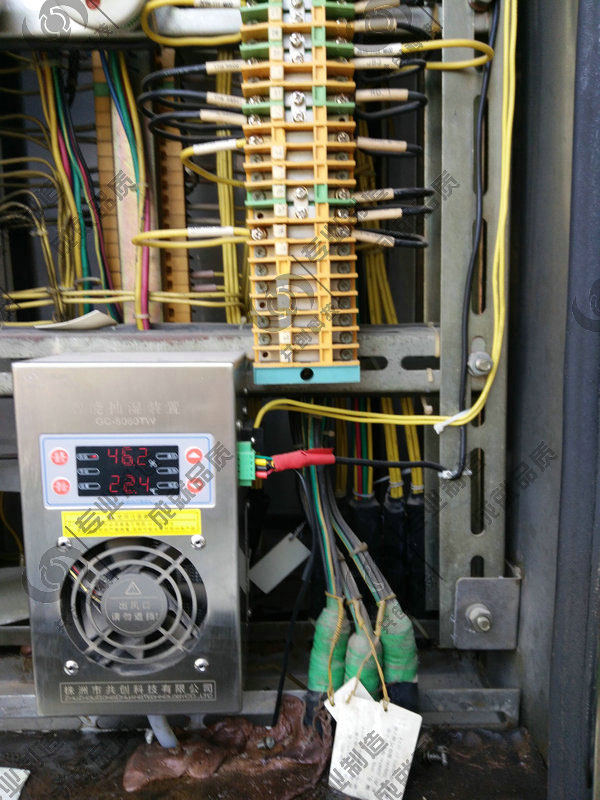
Between 2014 and 2016 we documented twelve substation retrofits. Seven have recorded dry-down times, one is a whole-station replacement, and the rest are photo records only. Site names are generalised by region.
| Site | Voltage | Enclosure | Volume | Ambient | Result | Dry-down |
|---|---|---|---|---|---|---|
| Coastal substation, Guangdong | 220 kV | Control cabinet | 1.5 m³ | Above 80% RH year-round | Dried with a 60W smart dehumidifier | 3 h |
| Mountain substation, Hunan | 110 kV | Control cabinet | 1.5 m³ | About 80% RH year-round | High-humidity alarm fully cleared | 3–4 h |
| Mountain substation, Guangxi | 220 kV | Control cabinet | 1.5 m³ | Above 80% RH | Damp problem fully resolved | 4 h |
| Suburban substation, Hunan | 220 kV | Outdoor GIS breaker cabinet | 1.5 m³ | About 80% RH in plum-rain season | Held at 70% RH | 4 h |
| Suburban substation, Guangxi | 220 kV | Outdoor terminal box | 1.0 m³ | About 80% RH annual average | Held below 70% RH | 1 h |
| Substation, Hunan | 220 kV | 10 kV switchgear | 1.5 m³ | Above 70% RH year-round | Held below 70% RH | 4 h |
| Substation, Jiangxi | 110 kV | 35 kV switchgear | 2.0 m³ | About 80% RH in plum-rain season; severe damp had caused an outage for repair | Held below 60% RH | 4 h |
| Substation, Hunan | 500 kV | Whole station | Multiple cabinets | Original temperature-control devices failed | 66 dehumidifiers installed, spares held on site | July 2016 |
| Gongchuang project records, 2014–2016. A second Guangxi 110 kV terminal box (1.0 m³) was also held below 70% RH; no dry-down time was recorded. |
Three things stand out for anyone planning substation cabinet dehumidification:
- Doubling the volume did not double the time in a straight line. The 1.0 m³ terminal box dried in one hour; the 2.0 m³ switchgear took four.
- The terminal box dehumidifier finished three to four times faster than the units in control cabinets only 0.5 m³ larger. Sealing and starting moisture made the difference, not volume.
- The 2.0 m³ switchgear that had already failed was held below 60% RH. Cabinets with a history of damp or discharge need a stricter target, not necessarily a bigger machine.
The Guangdong coastal case was also a direct comparison: from 9 October to 9 December 2014, the site ran temperature controllers and dehumidifiers side by side over two months before choosing the dehumidifier.
Across twelve sites, the common factor was not volume. Capacity is easy to choose; leakage is hard to cure.
Why the Same 60W Unit Took One Hour Here and Four Hours There
| Phase | What the dehumidifier is doing | What controls it |
|---|---|---|
| Initial dry-down | Removing water already in the air and in damp surfaces, cables and insulation | Starting moisture and how much water the materials have absorbed |
| Steady state | Removing the water that keeps leaking in | Door gaskets, cable entries, breather holes and seams |
The numbers make the point. Drying the air in a 1.5 m³ cabinet from 30°C and 80% RH to 70% RH means removing only about 4.5 g of water vapour, roughly 11 kJ of latent heat. A 60W unit rated at about 450–590 mL per day handles that in minutes, not hours. The fact that real cabinets took three to four hours shows where the time goes: moisture stored in surfaces and materials, plus air leaking in through every gap.
That is also why sizing substation cabinet dehumidification purely by cubic metres is unreliable. A volume rule gives a starting point, nothing more. The 1.0 m³ terminal box dried in one hour and the 1.5 m³ control cabinets took three to four, and the difference was not the extra half cubic metre. It was how well each one was sealed. Our guide to how dehumidifiers work explains the heat and water balance in more detail.
Fix the leaks first, then choose the machine.
The Substation Cabinet Dehumidification Retrofit: Seven Steps
| Step | What to do | Evidence to keep |
|---|---|---|
| 1. Trace the water | Find where water enters: door gaskets, cable entries, cabinet base, wall bushings, adjacent cable trenches | Site photos and a five-point checklist |
| 2. Set the target | Choose RH and dew-point margin by cabinet type: 70% standard, 60% for severe sites | Written into the technical agreement |
| 3. Measure the starting state | Record inside temperature and humidity, the coldest surface temperature, and outside conditions | Without this baseline, "four hours" cannot be verified |
| 4. Choose capacity | Size from measured dry-down in similar cabinets, not a volume formula | Reference the twelve-site record |
| 5. Position the unit | Lower part of the cabinet, bottom-in and top-out airflow, away from heat sources and dead zones behind the door | Airflow sketch |
| 6. Build the drain | Continuous downward slope, frost protection, no blockage, no backflow | The step most retrofits get wrong |
| 7. Accept the work | Dry-down, hold and power-off tests | See the acceptance table below |
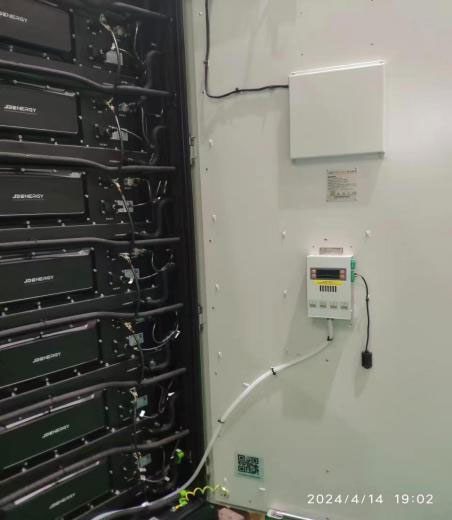
For mounting, we use the same rules across substations and battery cabinets: install the unit about 0.7–1 m above the cabinet floor, place the sensor 0.2–0.4 m from the air inlet, and keep the outlet clear so dry air circulates to the top of the enclosure.
Of the seven steps, one is buying a machine. The other six stop it from being a wasted purchase.
The Drain Is Where Retrofits Fail
Removing water is only half of substation cabinet moisture removal; the other half is getting that water out of the enclosure for good.
| Failure mode | Cause | Fix |
|---|---|---|
| Hose runs uphill or loops up | Limited space forces the hose upward | Re-route with a continuous fall, or use a unit that does not need a gravity drain |
| Water trap in the hose | A sagging loop holds standing water | Remove the loop; standing water blocks airflow and condensate backs up into the unit |
| Ice blocks the hose in winter | Water left in the hose freezes in cold or high-altitude sites | Insulate or trace-heat the hose and keep the run short and steep |
| Algae and dust block the hose | Long service with damp, warm conditions | Inspect and flush the hose during annual maintenance |
| Water flows back into the cabinet | The hose end sits in standing water or inside a flooded cable trench | Discharge to an open drain above the water line |
| Condensate drains onto the cabinet floor | A shortcut during installation | Never do this; it only moves the water |
If the drain is wrong, the only result of the retrofit is that the water changed places.
The same drain discipline matters wherever panels sit in wet areas; our guide to Food Plant Dehumidification covers washdown panels, where cleaning water adds a second source of moisture.
Sealing vs Breathing: Resolving the Contradiction
| Approach | Result |
|---|---|
| Fully sealed, no dehumidifier | Water vapour is locked inside and condenses with every day–night swing |
| Breather holes or exhaust fans | Humid outside air is drawn in continuously, worst in the rainy season |
| Sealed, plus a dehumidifier | Liquid water, insects and dust are kept out; vapour is actively removed |
For an outdoor terminal box dehumidifier or a switchgear unit alike, the principle is the same: seal against water, insects and dust. Manage vapour with a dehumidifier, not with a hole.
The Acceptance Test: Write This Into the Purchase Order
| Test | Condition | Pass criterion | Duration |
|---|---|---|---|
| A. Dry-down | Start above 80% RH | Reaches 70% RH (or 60%) | Within 4 h |
| B. Hold | Door closed, normal operation | No rebound above target | 24 h |
| C. Power-off hold | Dehumidifier switched off | No condensation on any surface | 4 h |
| D. Door-open recovery | Door open 5 minutes, then closed | Returns to target | Within 2 h |
| E. Drain | Continuous operation at full load | No standing water, backflow or leaks | 7 days |
| Gongchuang's recommended acceptance protocol. Adjust targets to your utility's own specification. |
A substation cabinet dehumidification retrofit without an acceptance test is just an installation.
Seasonal Behaviour: Plum Rain vs Winter
| Season | Main risk | Plan emphasis |
|---|---|---|
| Plum rain and summer | High water content; condensation on cold surfaces | Dehumidification first, with stricter RH targets |
| Winter | Lower water content, but large temperature swings and cold enclosures | Dehumidifier runs less often; add heating for freeze protection where needed |
| Typhoons and storms | Liquid water entering the cabinet | Sealing and drainage take priority over dehumidification |
| Long outages | No load heat; cabinet tracks ambient temperature | Power-off hold becomes the critical measure |
What a 500 kV Whole-Station Retrofit Looks Like
500 kV substation, Hunan, July 2016
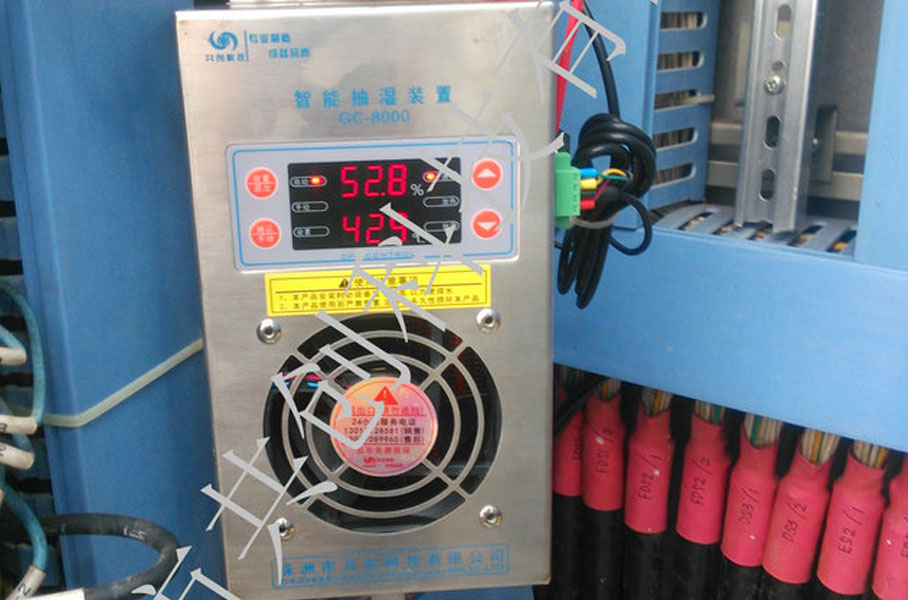
The original temperature-control devices inside the station’s cabinets had failed. Rather than replace them one by one, the maintenance team changed the approach: 66 GC-series dehumidifiers (model GC-8602L-D) were installed, one per cabinet, with spare units held on site.
Three things made it work:
- One standard model across the station, so any spare fits any cabinet.
- Enough spares to swap a unit within the same maintenance window.
- A documented installation date and unit count per cabinet, so the next inspection starts from a known baseline.
The hard part of a whole-station retrofit is not the 66 machines. It is making sure the 67th can replace any one of them at short notice.
Why Gongchuang
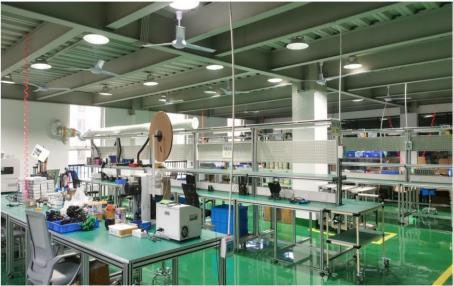
Substation cabinet moisture removal is what our cabinet units were designed for. Zhuzhou Gongchuang Technology has made enclosure dehumidifiers and temperature-humidity controllers in Zhuzhou, Hunan, since 2007. The plan in this article is not a laboratory recommendation; it comes from substation retrofits we carried out ourselves, including a 500 kV whole-station replacement.
Plan Your Substation Cabinet Retrofit
What we can supply for a substation programme:
- GC Series switchgear dehumidifiers from 15W to 80W, with dew-point control on T models
- High-capacity 120W units for switchgear and ring main units, including models with built-in condensate atomisation where no drain route exists
- DC-powered units for cabinets fed from the station DC system
- Heater outputs for sites that also need freeze protection, and RS485 or wireless communication so a failed unit raises an alarm
- Batch documentation: model, quantity, installation date and cabinet ID for every unit
Send us the cabinet type, internal volume, ambient conditions and whether a gravity drain exists. We will propose a unit and a dry-down estimate, and tell you what to seal before it arrives. Learn more about Gongchuang as an industrial dehumidifier manufacturer, see our power industry applications, or contact our engineers.
Frequently Asked Questions
Is 60W enough for a 1.5 m³ substation cabinet?
In our recorded retrofits, yes: in coastal and mountain substations at 80% RH or more, a 60W unit brought 1.5 m³ control cabinets below 70% RH in three to four hours. That assumes the cabinet has no major leaks. With worn door gaskets or open cable entries, the same unit may never reach the target, so seal first and size second.
Can I replace a failed heater with a dehumidifier directly?
Yes. In a 500 kV whole-station retrofit, 66 dehumidifiers replaced cabinets whose original temperature-control devices had failed. Plan a drain route for every unit, and if the site also needs freeze protection, keep or add a separate heating circuit rather than expecting one device to do both jobs.
Why does a heater keep a cabinet dry in theory but not in practice?
A heater changes temperature, not water content. Heating a 1.5 m³ cabinet from 30°C at 80% RH to 40°C drops relative humidity to about 48%, but the cabinet still holds about 36 g of water vapour. When the heater fails or station power is lost, the temperature falls and relative humidity returns to 80%.
How do I know a substation cabinet dehumidification retrofit worked?
Run three core tests: dry-down from above 80% RH to the target within four hours, 24 hours of holding the target with the door closed, and four hours without condensation after the dehumidifier is switched off. Passing only the first test proves the unit, not the plan.
What if the cabinet has no drain route?
Use a unit that does not need a gravity drain, such as a model with built-in atomisation of the condensate, or route a hose to a point outside the cabinet. Never let condensate drain onto the cabinet floor; that simply moves the water from the air to the base of the enclosure.