
Industrial Dehumidifier for Warehouse: Size the Door First
Ask how to size an industrial dehumidifier for warehouse use and you will usually get a formula built on cubic metres: volume × air changes × a factor. It is the standard answer, and in a warehouse it is often the wrong question.
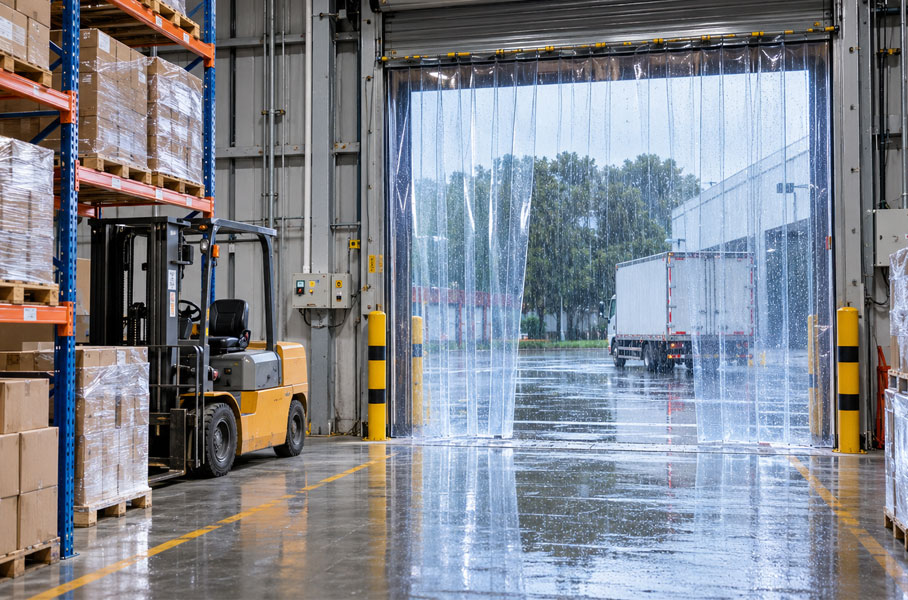
A warehouse is not just a large room. It is a room with an enormous door and a very large sponge inside it. The air in a big shed turns over slowly, often well under one change per hour. But the water does not arrive the way the formula assumes. It arrives in pulses through a dock door opened for half an hour; it arrives already inside pallets and cartons, which absorb moisture for weeks and release it for weeks afterwards; and it arrives on the underside of the roof at four in the morning, when the steel drops below the dew point and starts to drip onto whatever is stored beneath.
This guide sizes a dehumidifier for warehouse use against those loads, shows the arithmetic, and then says what many suppliers will not: for a large, busy warehouse, dehumidifying the whole volume is rarely the economic answer. Reduce the load first, condition the critical zone second, and buy equipment third. It is written by the engineering team at Zhuzhou Gongchuang Technology, an industrial dehumidifier manufacturer whose cabinet units protect the electrical panels inside warehouses, substations and energy storage sites.
Key Takeaways
- Warehouse moisture comes mainly from door openings, from goods and pallets, and from condensation on cold surfaces.
- One 30-minute opening of a 3 × 3 m dock door in 30°C/80% RH weather brings in about 28 kg of water, more than 13 hours of a 50 L/day dehumidifier’s output.
- Corrugated cartons lose roughly 30% of their stacking strength at 80% RH and 35–40% at 90% RH.
- Above about 15°C use refrigerant dehumidifiers; below about 10°C or for low dew points use desiccant.
- In winter, ventilation can dry a warehouse; in a humid summer, the same ventilation wets it.
The Short Answer
| Question | Answer |
|---|---|
| Where does warehouse moisture come from? | Infiltration and dock door openings, moisture held in goods and pallets, condensation on cold roofs and walls, then people and processes |
| Can I size by volume? | Only as a first estimate; door loads arrive in peaks that a volume formula does not see |
| Typical RH targets | Bare steel below 60%; cartons and wood about 45–60%; general dry goods below 60% |
| Which technology? | Refrigerant above about 15°C; desiccant below about 10°C or for low dew points |
| Dry the whole building? | Rarely economic for large, busy sites; zone the critical goods instead |
Every answer in this table changes how you choose an industrial dehumidifier for warehouse storage, so each row is explained below.
Do not size the room. Size the door.
Load One: The Door
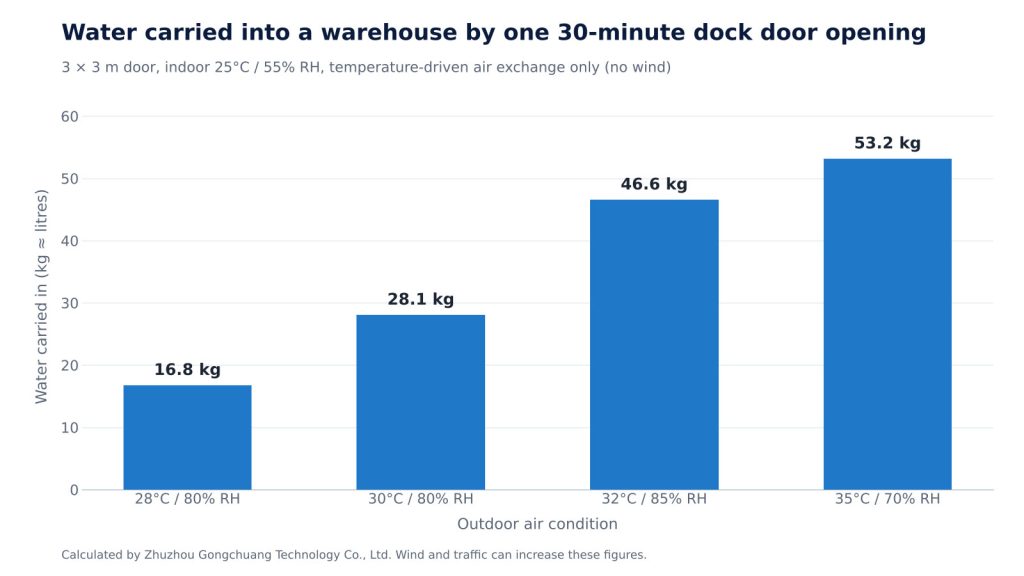
When a dock door opens, warm, humid outdoor air and cooler indoor air swap places through the opening: warm air flows in at the top while cooler air flows out at the bottom. For a door driven only by the temperature difference, the exchange rate can be estimated with a standard two-way flow formula:
Q ≈ (Cd / 3) × W × √( g × H³ × ΔT / T )
Cd ≈ 0.6 (discharge coefficient), W and H = door width and height (m), ΔT = outdoor − indoor temperature (K), T = absolute temperature (K)
A Worked Example
| Item | Value |
|---|---|
| Door | 3 m × 3 m |
| Outdoor air | 30°C, 80% RH (21.5 g water per kg dry air) |
| Indoor target | 25°C, 55% RH (10.9 g/kg) |
| Air exchanged | about 1.26 m³/s, or 2,640 kg of air in 30 minutes |
| Moisture difference | about 10.7 g/kg |
| Water carried in | about 28 kg (28 litres) |
| Equivalent output of a 50 L/day dehumidifier | about 13.5 hours |
| Temperature-driven exchange only. Wind blowing into the dock, forklift traffic and pressure differences can raise the figure considerably. |
While the door is open, it delivers water at a rate of about 56 kg per hour, more than the entire background infiltration of a 12,000 m³ building. That is the peak a volume formula never sees, and the reason a dehumidifier for warehouse docks so often seems undersized. Ways to cut it:
- High-speed roll-up doors, dock shelters and air curtains
- PVC strip curtains, which still allow forklift traffic
- Fewer, shorter openings: the time a door stands open matters more than how often it opens
- Separating the loading dock from the storage hall, often the highest-return change in the whole building
What you are really buying is door management, not just a dehumidifier.
Load Two: The Goods Are a Sponge
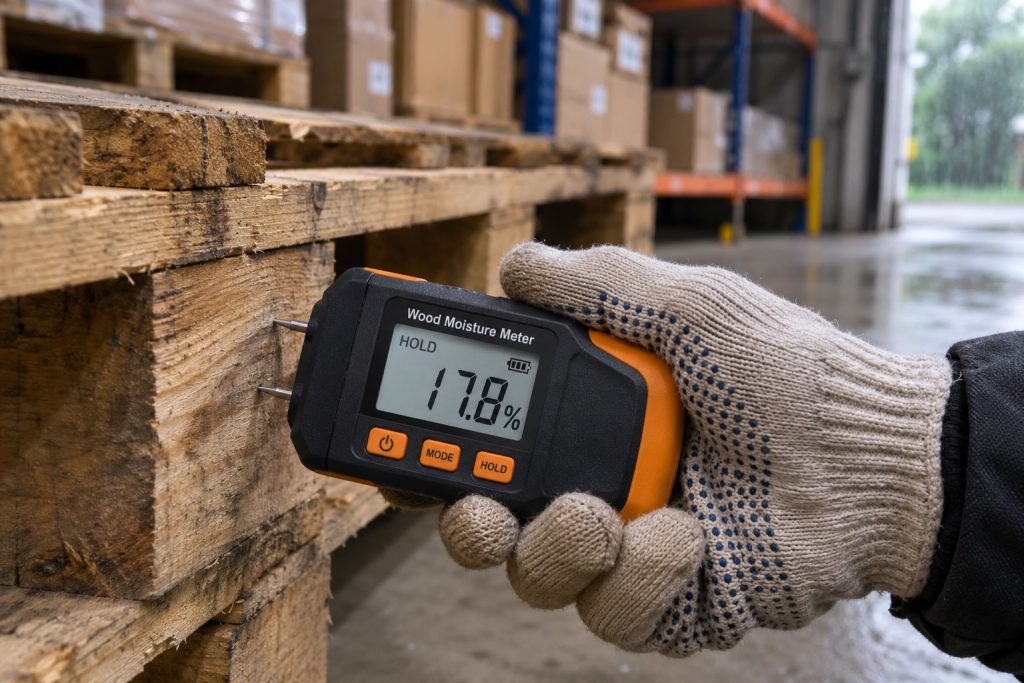
Wood and paper absorb water from humid air and release it when the air dries. In a warehouse they hold far more water than the air does.
| Material | Moisture content in balance with the air | What it means |
|---|---|---|
| Wooden pallet (about 22.5 kg of dry wood) | About 11% at 60% RH; about 20% at 90% RH | Holds about 2.5 kg of water at 60% RH and 4.5 kg at 90% RH |
| Corrugated board | About 7% at 50% RH; about 13% at 90% RH | Absorbed water weakens the board |
| Wood moisture content on a dry basis at room temperature; corrugated board on a wet basis. |
A thousand pallets drying from 20% to 11% release about 2 tonnes of water. That is why RH can keep rising for hours or days after the doors are shut, and why a new dehumidifier for warehouse storage often seems to “do nothing” in its first week.
Carton Strength Falls With Humidity
| Relative humidity | Box compression strength (vs 50% RH) |
|---|---|
| 50% | 100% (reference) |
| 80% | About 68–73% (a loss of roughly 27–32%) |
| 90% | About 60–65% (a loss of roughly 35–40%) |
| Derived from Georgia Tech Institute of Paper Science and Technology analysis and Fibre Box Association data. |
Stack heights designed for cartons at 50% RH can collapse in a humid season. For many warehouses, crushed cartons, not mould, are the most common moisture damage. Very dry air is not ideal either: paperboard becomes more brittle when it is too dry, so lower is not automatically better.
The biggest water tank in a warehouse is the paper and wood on its racks.
Load Three: Condensation on Surfaces, Not in the Air
Condensation is decided by surface temperature versus dew point, not by the RH reading. At 25°C and 60% RH the dew point is about 16.7°C; any surface below that temperature collects water. Our guide to what relative humidity is explains why the room reading can mislead.
| Location | Why it condenses |
|---|---|
| Underside of the roof and purlins | On clear nights the roof radiates heat to the sky and can fall several degrees below air temperature |
| Inside face of external walls | Cold in winter and at night |
| Goods stacked against walls | Sit in a cooler, damper pocket than the room sensor measures |
| Cold goods arriving from cold chain | Their surfaces "sweat" as soon as they enter warmer, humid air |
Practical layout rules: keep a clear gap between goods and external walls, keep goods off the floor on pallets or dunnage, do not stack up to the roof deck, and let cold goods warm up in a closed area before opening their wrapping.
The air does not condense. Surfaces do.
What RH Should a Warehouse Hold?
Set the target by the most moisture-sensitive goods you store, not by a general rule.
| Stored material | Suggested RH | Reason |
|---|---|---|
| Bare carbon steel and cast iron | Below 60%; precision parts 45–55% | Atmospheric corrosion accelerates above about 60% RH |
| Copper and brass | Below 60% | Tarnish and oxidation |
| Electronic components and PCBs | 60% or lower | J-STD-033 rates moisture-sensitive device floor life at 30°C/60% RH or below |
| Cartons and paper | About 45–60% | Strength loss when damp; brittleness when very dry |
| Wood and furniture | About 45–60% | Dimensional stability |
| Textiles and leather | About 45–60% | Mould risk rises sharply around 70% and above |
| Bagged cement and powders | Below 60% | Caking |
| Fertilisers and chemical powders | Below the product's critical relative humidity | Some products absorb water and cake around 60% RH or lower |
These are storage guidelines based on material behaviour, not process specifications. Pharmaceuticals, food and hazardous chemicals must follow their own GMP, regulations and stability data.
Find the one pallet that hates moisture most, and set the line for it.
Sizing a Dehumidifier for Warehouse Use: Five Loads, Then a Safety Factor
| Load | How to estimate it | Notes |
|---|---|---|
| 1. Infiltration | ACH × V × ρ × ΔW ÷ 1,000 (kg/h) | Warehouses often run at about 0.25–0.5 ACH |
| 2. Door openings | Openings per day × water per opening | Total it per day, and check the peak during an opening |
| 3. Goods and pallets | Incoming quantity × moisture content difference | Cartons and pallets delivered in the rainy season |
| 4. People | Roughly 0.05–0.2 kg/h per person, depending on activity | Small, but not zero |
| 5. Building envelope | Significant for uninsulated metal roofs and leaky walls | Often the hidden load in older buildings |
Sizing an industrial dehumidifier for warehouse use starts with this table. Multiply the total by a safety factor of 1.15–1.25, and take every equipment rating at your design condition. Refrigerant dehumidifiers are often rated at 30°C and 80% RH, desiccant units often at 20°C and 60% RH; comparing catalogue figures directly can be off by a factor of two or more.
Worked Example: 2,000 m² × 6 m (12,000 m³)
| Item | Value |
|---|---|
| Infiltration at 0.3 ACH (30°C/80% outside, 25°C/55% inside) | about 44.5 kg/h |
| Door: 3 openings × 30 minutes per day | about 84 kg/day, or 3.5 kg/h averaged |
| Total with a 1.15–1.20 safety factor | about 55–58 kg/h |
| Goods, people and envelope loads not included; add them for a real project. |
Holding the whole building at 55% RH at this scale needs a large central system removing well over a tonne of water a day. That is why zoning the critical goods is usually a better choice than one industrial dehumidifier for warehouse-wide drying.
Do all five sums before deciding whether the whole building needs treating.
What Is the Best Dehumidifier for a Warehouse? Temperature Decides
Buyers often ask for the best dehumidifier for warehouse storage as if one model fits every building. There is no single best dehumidifier for warehouse use; the right technology depends on the temperature of the space and the dryness you need.
| Conditions | Choice |
|---|---|
| Above about 15°C, target 40–60% RH | Refrigerant (compressor), usually more efficient |
| About 10–15°C | Compare both; refrigerant units need good defrost |
| Below about 10°C | Desiccant |
| Dew point target below about 5°C, or RH below about 35% | Desiccant |
| Cold stores and their anterooms | Desiccant, with regeneration air ducted outdoors |
A commercial dehumidifier for warehouse use, typically a portable or ducted refrigerant unit, loses capacity steeply as the air cools: its coil runs near or below 0°C, frost builds and defrost cycles take running time away. In a cold store, the best dehumidifier for warehouse conditions is therefore usually desiccant. Desiccant units keep working in the cold and need no drain, but their regeneration uses more energy and warms the dried air. Our article on dehumidifier energy usage covers the running cost side, and how dehumidifiers work explains both technologies.
15°C is an engineering boundary, not a sales line.
The Season Flips the Strategy
| Season | Outdoor moisture | Right strategy |
|---|---|---|
| Winter (cold, dry outside) | Low | Ventilation is dehumidification; mild heating also helps |
| Rainy season and summer (hot, humid outside) | High | Keep the building closed and dehumidify; an open door adds water |
| Spring and autumn | Varies by day | Decide by dew point, not by RH |
A dehumidifier for warehouse use should be switched by this logic too. The rule is to compare the outdoor dew point with the indoor target dew point. Outdoor air at 5°C and 80% RH has a dew point of only about 1.8°C, far drier than indoor air at 25°C and 55% RH (dew point about 15.3°C), even though its RH reading is higher. For more on dew point targets, see our guide to dew point dehumidification.
In winter the door is a dehumidifier. In summer it is a humidifier.
Air Distribution: Why a Unit on the Floor Does Little
| Problem | Result | What to do |
|---|---|---|
| Stratification | Warm air rises; at 25°C/55% RH, a 3°C difference shifts RH by about 10 points | Duct or jet dry air into the racking aisles |
| Dead corners | Air along walls and corners does not move | Add circulation fans |
| Blowing directly on goods | Local over-drying and cracked cartons | Keep airflow even and indirect |
| Sensor on the dehumidifier | Reading does not represent the racking | Put sensors at the most sensitive storage locations |
Reduce the Load Before Buying Anything
| Measure | Relative cost | Effect |
|---|---|---|
| Separate the dock or add a vestibule | Low to medium | Cuts the largest peak load |
| High-speed doors or strip curtains | Low | Less water per opening |
| Repair roofs and walls; add vapour barriers | Medium | Cuts envelope moisture |
| Keep goods off walls and floors | Very low | Removes local condensation |
| Let cold goods warm up before unwrapping | Low | Stops "sweating" |
| Zone the critical goods | Medium | Shrinks the volume to be dried, often to a small fraction of the building |
Only after these steps should you size a commercial dehumidifier for warehouse zones. Food warehouses add hygiene requirements; our guide to food plant dehumidification covers zone targets for production areas.
What to Put in the Specification
| Item | Why |
|---|---|
| Target RH and allowed band | A single number cannot be accepted or rejected |
| Capacity at your design temperature and RH | Catalogue conditions differ and can mislead by a factor of two |
| Door openings and durations | Sets the peak load |
| Stored materials and incoming moisture | Sets the goods load |
| Lowest ambient temperature | Decides refrigerant or desiccant |
| Air distribution and throw | Decides whether the racking actually reaches target |
| Controls and logging, such as RS485 | Verification and traceability |
| Drain and regeneration exhaust routes | Must be confirmed before installation |
The Electrical Layer Inside the Warehouse
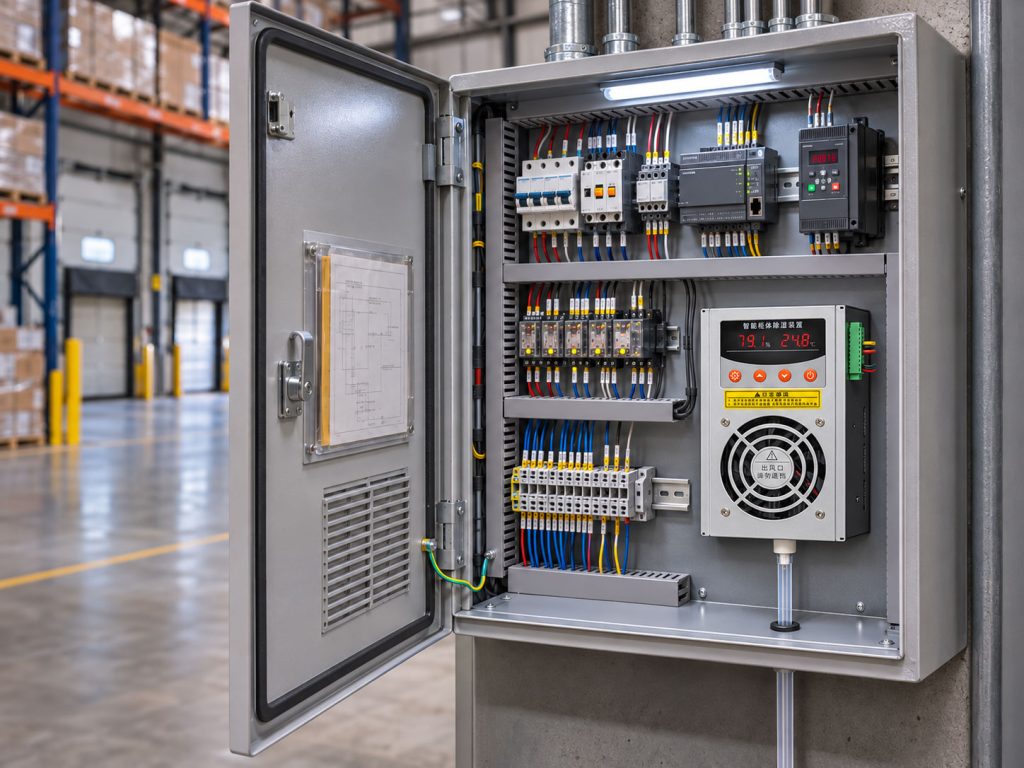
Distribution boards, lighting control boxes, dock door controllers, fire alarm panels and cold-room control cabinets in a warehouse face the same night-time cooling and humid air as the goods. The symptoms are falling insulation resistance, oxidised terminals and nuisance trips, often blamed on electrical faults rather than moisture. This is where Gongchuang’s products fit. See condensing vs desiccant cabinet dehumidifiers and how an electrical panel dehumidifier works.
Why Gongchuang
Zhuzhou Gongchuang Technology has built moisture-control equipment in Zhuzhou, Hunan, since 2007, and most of what we ship is compact: dehumidifiers that fit inside a cabinet, a switchgear compartment or a control panel. That experience is why we start a conversation about an industrial dehumidifier for warehouse projects with the load, not with a unit.
Request a Warehouse Humidity Assessment
- We tell you whether the building needs conditioning at all, or whether the money belongs in a dock vestibule
- We work at your actual design condition, not a catalogue point
- We separate the room problem from the enclosure problem, because the fix and the budget are different
- For the electrical layer, we supply switchgear and DIN rail cabinet dehumidifiers directly, with RS485 monitoring
- Custom voltage, housing and communication options for OEM and export programmes
Send us the floor plan, the door schedule and your most moisture-sensitive stored material, and we will send back a load estimate before any quote. Learn more about Gongchuang as an industrial dehumidifier manufacturer, browse our cabinet dehumidifiers, or contact our engineers.
Frequently Asked Questions
What size dehumidifier do I need for a warehouse?
Not one you can read off floor area or volume. Add up five loads: infiltration, door openings, moisture released by goods and pallets, people, and the building envelope, then apply a safety factor of 1.15–1.25. A 2,000 m² warehouse with a 6 m ceiling, 0.3 air changes per hour, three 30-minute door openings a day and a 25°C/55% RH target against 30°C/80% RH outdoor air needs roughly 55–60 kg of water removed per hour.
Can one dehumidifier handle a whole warehouse?
For a large, busy warehouse, usually not economically. Infiltration alone can reach tens of kilograms of water per hour, which needs a large, continuously regenerating system. It is usually cheaper to cut the door load first and then condition only the zone where sensitive goods are stored.
What humidity should a warehouse be kept at?
It depends on the most moisture-sensitive goods. Bare carbon steel is safest below about 60% RH, precision steel parts at 45–55%; corrugated cartons and wood at roughly 45–60%; moisture-sensitive electronic components are rated for floor life at 30°C and 60% RH or below. For general dry goods, 45–60% RH is a common range.
Why is my warehouse damp when the hygrometer reads 55%?
Because condensation happens on cold surfaces, not in the air. At 25°C and 60% RH the dew point is about 16.7°C, so any roof deck, external wall or goods stacked against a wall that falls below that temperature at night will get wet, whatever the room sensor reads.
What is the best dehumidifier for a warehouse: refrigerant or desiccant?
Decide by temperature. Above about 15°C with a target of 40–60% RH, refrigerant dehumidifiers are usually more efficient. Below about 10°C, or where a dew point below about 5°C is needed, refrigerant units lose capacity and frost, and desiccant dehumidifiers are the better choice.
Do I need to run a warehouse dehumidifier in winter?
Often not. When the outdoor dew point is below the indoor target dew point, as on many winter days, ventilation itself removes moisture. In a humid summer the opposite is true and opening doors adds moisture. Compare dew points, not RH readings.
How long does it take to dry a warehouse after a door is left open?
Longer than most people expect. One 30-minute opening of a 3 × 3 m door in 30°C/80% RH weather can bring in about 28 kg of water by temperature-driven exchange alone, roughly 13–14 hours of output for a 50 L/day dehumidifier, and pallets and cartons keep releasing absorbed moisture for days afterwards.
References
- Georgia Tech, Institute of Paper Science and Technology, “Effects of Moisture Content on Box Compression Strength”.
- USDA Forest Products Laboratory, Wood Handbook, equilibrium moisture content of wood.
- IPC/JEDEC J-STD-033, Handling, Packing, Shipping and Use of Moisture/Reflow Sensitive Surface Mount Devices.
- Psychrometric values calculated with the Magnus formula (WMO coefficients) at sea-level pressure.