Electrical Cabinet Dehumidifier: Condensing vs Desiccant
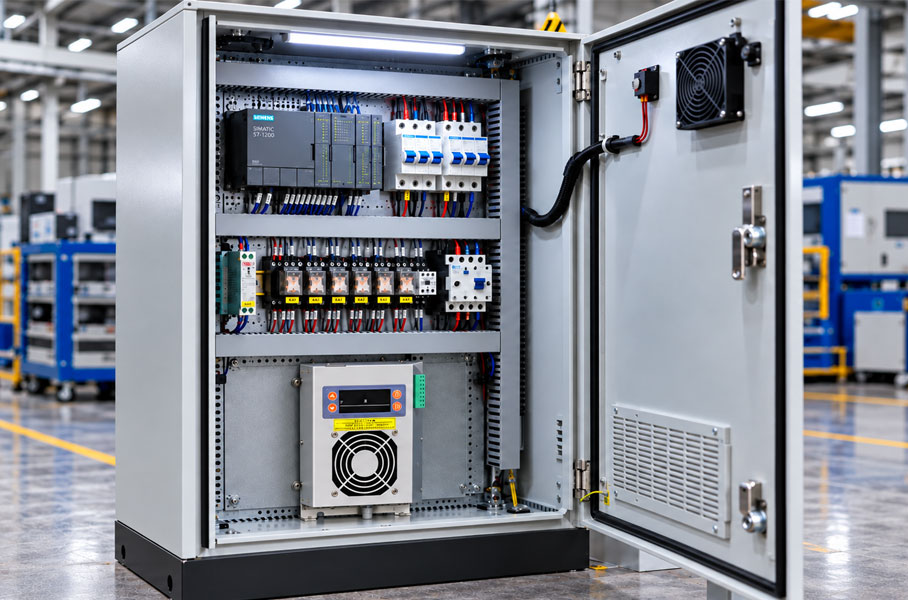
Electrical cabinets carry the components an automated plant or power network depends on: PLCs, relays, circuit breakers, drives and terminal blocks. Their reliability depends on the air around them. In monsoon seasons, coastal sites and regions with large day–night temperature swings, moisture enters the enclosure and condenses on cold surfaces. The result is corrosion, falling insulation resistance and, in the worst cases, short circuits, earth leakage or fire.
An electrical cabinet dehumidifier is the device that removes that moisture. This guide explains the two main technologies, condensing and desiccant, how smart control decides when they run, and how to choose and install the right unit. It is written by the engineering team at Zhuzhou Gongchuang Technology, an industrial dehumidifier manufacturer whose cabinet units have run on China’s power grids for more than ten years.
Key Takeaways
- Most electrical cabinet dehumidifiers use either thermoelectric condensing or desiccant adsorption.
- Condensing units drain water out as liquid; desiccant units release it as vapour during regeneration.
- A humidity sensor and controller switch the unit, typically on at about 60% RH and off at about 45% RH, or by dew point.
- Choose by cabinet volume, site temperature, target humidity and whether water can be drained.
- Mount condensing units upright in the lower half of the cabinet, with a downward-sloping drain.
Why Electrical Cabinets Need Dehumidification
Few cabinets are truly airtight. Humid air enters through cable glands, door gaskets and ventilation openings, and every heating and cooling cycle pulls more in. When the enclosure cools at night or after a shutdown, its steel walls and cable entries drop below the dew point of the air inside, and water condenses on them. Repeated wet and dry cycles corrode terminals and busbars and leave conductive films on insulating surfaces.
Anti-condensation heaters are the traditional answer, but they only warm the air to lower its relative humidity. The water stays in the cabinet and returns as condensation once the heater stops. Heaters also draw power continuously and can create local hot spots. An electrical cabinet dehumidifier takes the water out instead.
Two Ways to Remove Moisture From a Cabinet
1. Thermoelectric Condensing Dehumidifiers
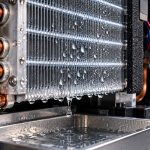
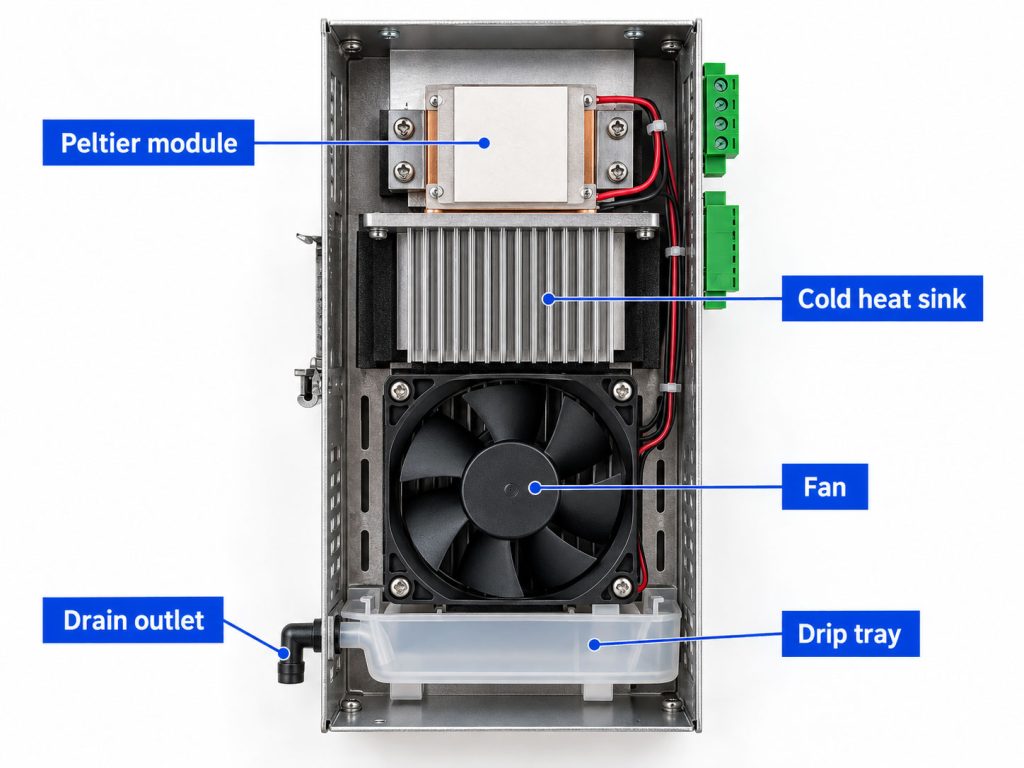
The most common electrical cabinet dehumidifier uses the Peltier effect. Direct current flows through a semiconductor module, making one side cold and the other side hot. A fan draws humid cabinet air across the cold-side heat sink, which sits below the air’s dew point, so water vapour condenses into droplets. The droplets run into a drip tray and leave the cabinet through a drain hose. The drier air returns to the cabinet, and the cycle continues.
Condensing units are compact and contain no compressor or refrigerant, so the only moving parts are small fans. They work best in warm, humid air. Gongchuang’s CSH series, for example, removes 588 mL/day at 60W under 35°C and 85% RH, in a housing just 47 mm thick. Output falls as air gets colder or drier, which is why many units add automatic defrost for frost on the cold plate and an optional output to switch a heater at low temperatures.
2. Desiccant (Adsorption) Dehumidifiers
A desiccant unit traps water vapour on an adsorbent such as silica gel or molecular sieve. Once the material is loaded, an electric heater warms it, driving the moisture off as vapour, which is vented out of the enclosure. The cycle then repeats. Because desiccants do not rely on a cold surface, they keep working in cold air and can reach lower humidity than condensing units.
Desiccant units do not produce liquid water inside the cabinet, but the moisture still has to go somewhere. Regenerating units need a vent or breather to release it, and that opening must be one the enclosure’s rating allows. Non-regenerating desiccant bags work without power but simply saturate and must be replaced, which is why most sites choose a cabinet dehumidifier electric enough to regenerate or drain itself.
Condensing vs Desiccant at a Glance
| Feature | Thermoelectric condensing | Desiccant (regenerating) |
|---|---|---|
| How water leaves | Liquid, through a drain hose | Vapour, through a vent during regeneration |
| Best conditions | Warm, humid air | Cold air or very low humidity targets |
| Weak point | Capacity falls in cold or dry air | Regeneration energy; needs a protected vent |
| Moving parts | Small fans | Fans and, in some designs, a valve or rotor |
| Consumables | None | None for regenerating units; bags must be replaced |
| Typical use | Switchgear, distribution and control panels, ESS cabinets | Cold sites, sealed telecom and instrument enclosures |
When you choose a cabinet dehumidifier, electric condensing or desiccant, the deciding factors are the site temperature and where the water can go.
Smart Control: How the Dehumidifier Decides When to Run
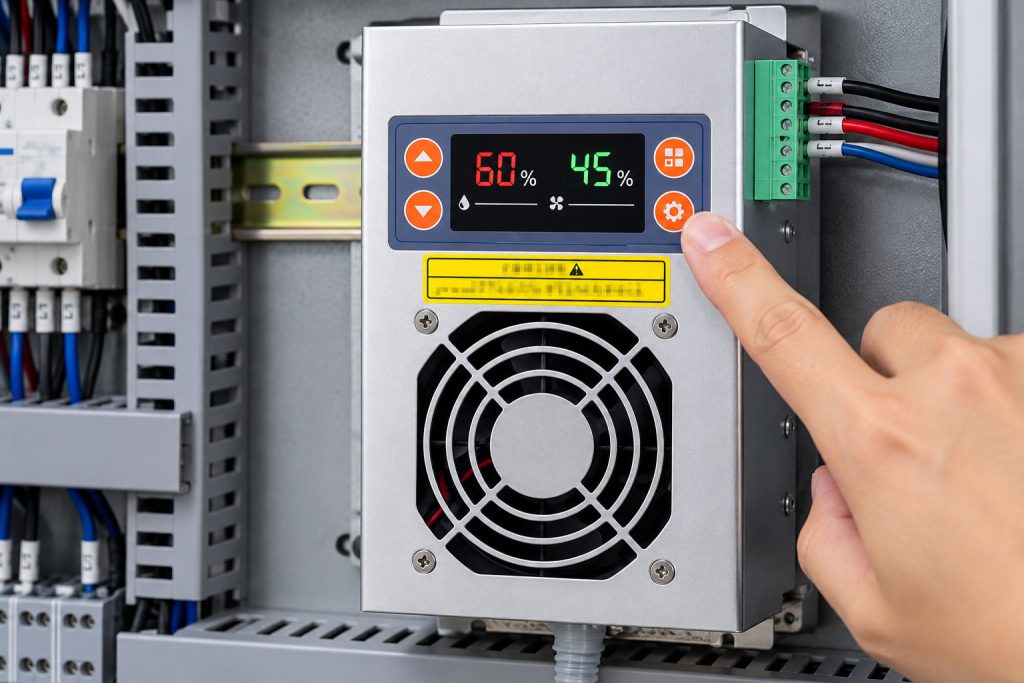
An electrical cabinet dehumidifier does not simply run all day. A digital temperature and humidity sensor feeds a microcontroller, which starts and stops drying against set points.
- Humidity control: a common setting starts drying at about 60% RH and stops at about 45% RH, then waits in low-power standby.
- Dew-point control: the controller calculates the dew point and starts drying before any surface can reach it. This is more precise because relative humidity changes with temperature. Our guide to dew point dehumidification explains why.
- Outputs and communication: many units provide a dry contact for a heater, fan or fault alarm, and RS485 communication so a monitoring system can read status and change settings remotely across many cabinets.
How to Choose an Electrical Cabinet Dehumidifier
Four factors decide the right unit: cabinet volume, how well the enclosure is sealed, the extreme temperature and humidity at the site, and the heat the equipment inside produces.
| Application | Main challenge | Usually suits |
|---|---|---|
| Outdoor box substations and ring main units | Wide temperature swings, heavy condensation | Condensing unit rated for a wide temperature range, with defrost and heater output |
| Indoor switchgear and distribution panels | Humid seasons, heat cycling | Condensing unit with humidity or dew-point control |
| Energy storage and battery cabinets | Cold liquid-cooling plates below the dew point | Condensing unit with dew-point control; DC power options |
| Washdown and food processing panels | Steam and spray cycling the seals | Condensing unit with a sealed drain path |
| Cold, sealed instrument or telecom enclosures | Too cold for a cold plate to work well | Desiccant unit with a protected vent |
For outdoor cabinets, remember that ingress protection comes from the enclosure, not the dehumidifier inside it. Choose a unit whose operating range covers the site: Gongchuang’s CSEB series, for example, operates from -25°C to 75°C and runs on 12V, 24V, 48V DC or 220V AC. For washdown environments, our guide to Food Plant Dehumidification covers how cleaning cycles drive moisture into panels.
Above about 5 m³, or where the moisture load is high, a single thermoelectric unit may not keep up. Use several distributed units, or a compressor dehumidifier for large enclosures and containers.
Installation: Where and How to Mount It
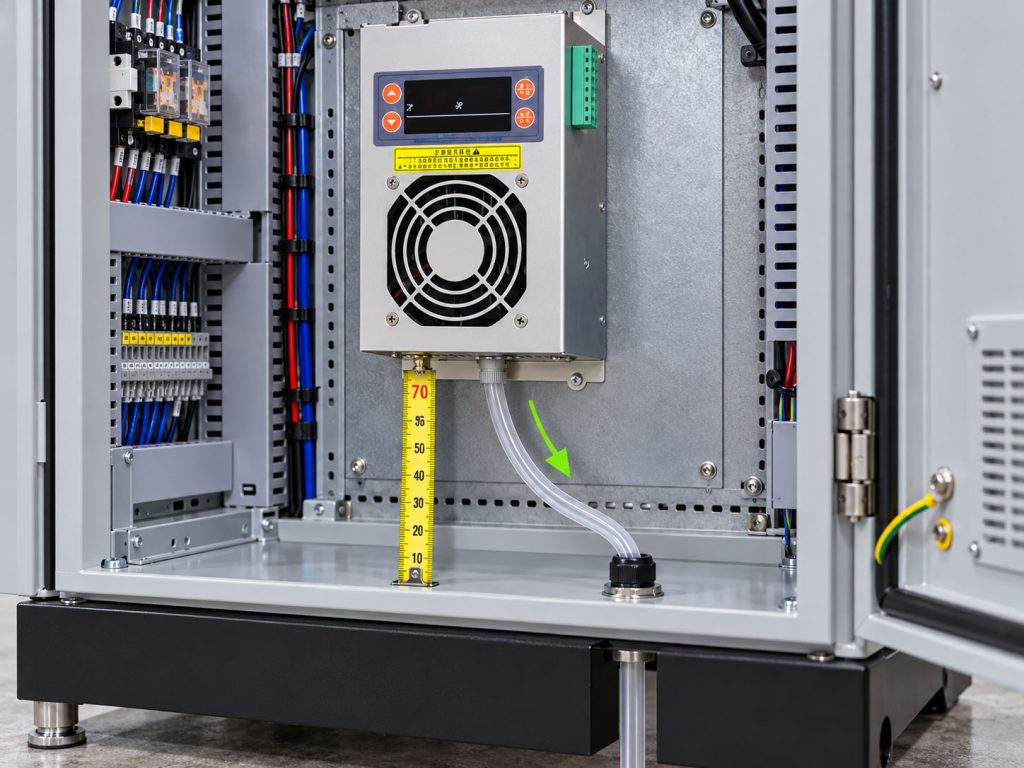
- Lower half of the cabinet. Mount the unit about 0.7–1 m above the floor, with at least 20 cm between the air inlet and the floor. The cooler air low in the cabinet is where condensation risk is highest, and a bottom-inlet, top-outlet airflow then circulates dry air upward through the whole enclosure.
- Upright only. Condensing units rely on gravity to carry water from the heat sink to the drain, so mount them in the orientation the manufacturer specifies.
- Clear airflow. Keep at least 10 cm above the outlet, and do not point the inlet directly at heat sources or dense cable bundles.
- Drain path. Route the hose downward all the way out of the cabinet, with no traps or long flat runs.
- Sensor position. Place the humidity sensor 0.2–0.4 m from the air inlet so it reads the humid lower air.
Maintenance
- Clean the electrical cabinet dehumidifier’s fan inlets and filters so airflow is not restricted.
- Check that the drain hose is clear, unkinked and still sloping downward.
- Inspect door gaskets and cable glands, the main paths for humid air.
- For desiccant units, confirm regeneration and the vent are working; replace non-regenerating bags on the manufacturer’s schedule.
For a step-by-step look at the condensing cycle itself, see how an electrical panel dehumidifier works.
Frequently Asked Questions
How does an electrical cabinet dehumidifier work?
A condensing unit uses a Peltier module to cool a heat sink below the dew point, so water vapour condenses and drains out of the cabinet. A desiccant unit adsorbs water onto silica gel or molecular sieve, then heats the material to release the moisture through a vent. Both are switched by a humidity sensor and controller.
Which is better for a cabinet, condensing or desiccant?
Condensing units suit warm, humid sites and cabinets that can route a drain hose. Desiccant units keep working in cold air and where very dry conditions are needed, but they release moisture as vapour during regeneration, so they need a protected vent. Choose by temperature, target humidity and whether water can be drained.
Can an electrical cabinet dehumidifier be mounted in any orientation?
No. Condensing units rely on gravity to carry water from the heat sink to the drain, so they must be mounted upright as the manufacturer specifies, with the drain hose sloping downward and free of traps.
At what humidity should a cabinet dehumidifier switch on?
A common setting is to start at about 60% RH and stop at about 45% RH. Dew-point control is more precise: the unit starts when the air’s dew point approaches the temperature of the coldest surface in the cabinet.
Find the Right Unit for Your Cabinets
Gongchuang builds thermoelectric dehumidifiers for switchgear, distribution panels, control cabinets and energy storage enclosures, including DIN rail, DC-powered and switchgear models. Browse our electrical cabinet dehumidifier range, or send us your cabinet size and site conditions for a recommendation from an experienced industrial dehumidifier manufacturer.