How Do Dehumidifiers Work? 3 Routes, Physics & Ratings
Content
Hide
Every dehumidifier on the market, from a small cabinet unit to a desiccant wheel treating thousands of cubic metres of air an hour, removes water vapour by one of three routes.
It condenses the water: cool the air below its dew point, let the moisture collect on a cold surface, and drain it away. It captures the water: pass the air through a desiccant that holds the moisture, then heat the desiccant to drive the moisture off. Or it separates and displaces the water: dry compressed air through a membrane and use it to purge an enclosure, so humid air never gets in.
Those three routes look completely different. But the ones that pull water out of the air all pay the same physics bill. Turning one kilogram of water vapour into liquid releases roughly 2,450 kilojoules of latent heat, about 0.68 kWh. That heat has to go somewhere. It is why a refrigerant dehumidifier blows warm air, why a desiccant wheel raises the temperature of the air it dries, and why a thermoelectric unit needs a hot side.
Then there is the part that makes catalogue numbers hard to compare: every dehumidifier’s capacity is rated at a specific temperature and humidity, and the efficiency metrics used for different technologies are not interchangeable. This guide answers how do dehumidifiers work across all three routes, the physics that unites them, how to choose between them, and how to read the numbers without being misled. It is written by the engineering team at Zhuzhou Gongchuang Technology, an industrial dehumidifier manufacturer of condensing cabinet dehumidifiers.
Key Takeaways
- All dehumidifiers condense water, capture it on a desiccant, or keep humid air out with dry-air purge.
- Removing water releases about 2,450 kJ per kilogram, so dehumidifiers add heat to the space they dry.
- Refrigerant units win in warm, humid air; desiccant units win in cold air and at very low dew points.
- Capacity ratings only mean something with their test conditions; US portable units moved from 80°F to 65°F testing in 2019.
- Room dehumidification and cabinet dehumidification are different problems that need different equipment.
How Do Dehumidifiers Work? Three Routes, One Physics Bill
So how do dehumidifiers work, whatever their size or price? The table sorts every type into one of three routes.
| Route | How it works | Typical technology | Where it is strongest |
|---|---|---|---|
| 1. Condense | Cool air below its dew point; water forms on a cold surface and drains away | Refrigerant (compressor), thermoelectric (Peltier) | Warm, humid air; proven and simple |
| 2. Capture | A desiccant holds the water vapour; hot air later drives it off | Desiccant rotor (silica gel, molecular sieve) | Cold spaces and very low dew points |
| 3. Separate and displace | Dry air, from a membrane dryer or other source, purges an enclosure and holds it above ambient pressure | Compressed-air membrane dryer, positive-pressure purge, vortex cooler | Sealed cabinets with instrument air available |
The short answer to how do dehumidifiers work: a dehumidifier does not make dryness. It moves water from one place to another and pays a heat bill for the move.
The Physics You Need Before Any of It Makes Sense
| Term | Plain definition | Why it matters |
|---|---|---|
| Absolute humidity | How much water the air actually holds | This is what dehumidification reduces |
| Relative humidity (RH) | Water held, divided by the most the air could hold at that temperature | Changes whenever temperature changes |
| Dew point | The temperature at which the air starts to condense | A condensing dehumidifier's coil must be colder than this |
| Latent heat | Heat released when vapour turns into liquid | The reason every dehumidifier adds heat |
You cannot answer how do dehumidifiers work without these four terms. RH is a ratio, so it moves whenever the temperature moves. Dew point is an absolute measure of how much water is in the air. That is why industrial users often set targets in dew point rather than RH. Our guide to dew point dehumidification covers that control approach in depth.
Route 1: Condense the Water
How a Refrigerant Dehumidifier Works
For most people asking how do dehumidifiers work, this is the machine they have in mind: the compressor unit in a basement, warehouse or plant room.
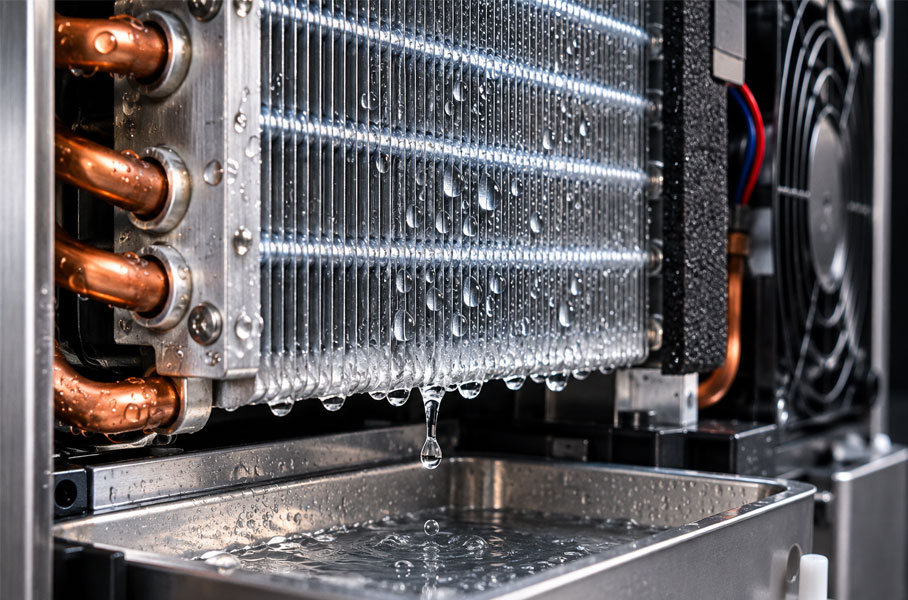
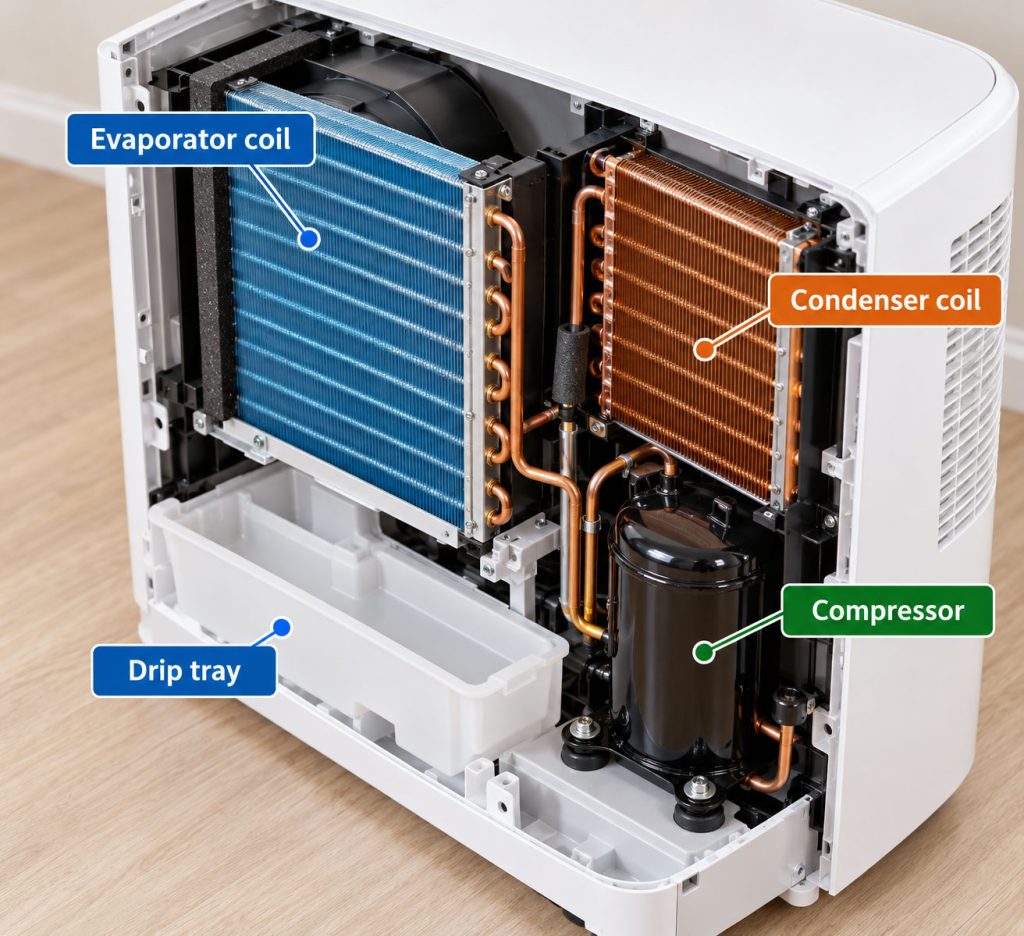
- A fan draws humid air across the evaporator coil.
- The coil is colder than the air’s dew point, so water vapour condenses on it.
- The water drips into a tray and leaves through a drain hose or into a tank.
- The now-cool air passes over the condenser coil and is reheated.
- The unit discharges air that is drier and slightly warmer than the air it took in.
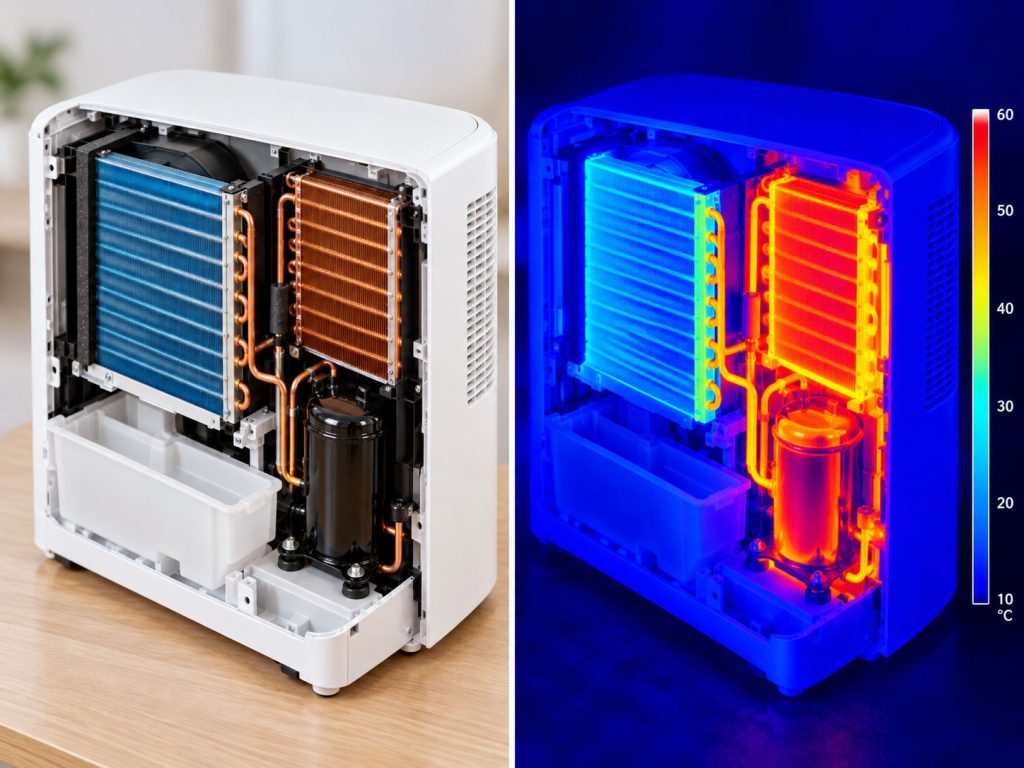
The warm air is not a heater at work. The condenser returns the heat the evaporator removed, plus the compressor’s work, to the airstream. Refrigerant units are efficient in warm, humid conditions. Their weakness is cold: as the air cools, there is less water to remove and the coil runs close to freezing. Once the coil surface drops below 0°C, condensate turns to frost, capacity falls and the unit must pause for defrost cycles. Cooling-based dehumidification is generally practical down to a dew point of roughly 40°F (4–5°C).
How a Thermoelectric (Peltier) Dehumidifier Works
If you are asking how do dehumidifier work inside a small cabinet, the answer is usually thermoelectric. A thermoelectric unit is the same principle in miniature. Direct current flows through a semiconductor module, making one face cold and the other hot. Moisture condenses on the cold-side heat sink and drains away, while fans carry heat off the hot side. There is no compressor and no refrigerant, so the unit can be very compact.
The trade-off is efficiency per kilowatt-hour, which is lower than a compressor’s. That matters for a room, but not for a cabinet. Gongchuang’s CSH series, for example, removes 588 mL/day at 60W under 35°C and 85% RH, in a housing only 47 mm thick: a small absolute energy load for a switchgear or control panel. For a closer look at the cycle, see how an electrical panel dehumidifier works.
A condensing dehumidifier makes it rain on a surface colder than the dew point, then carries the rain away.
Route 2: Capture the Water
How a Desiccant Dehumidifier Works
- Humid process air passes through a slowly rotating wheel with a honeycomb of silica gel or molecular sieve.
- The desiccant adsorbs water vapour, and dry air leaves the wheel.
- The wheel turns into a regeneration sector, typically about a quarter of its face.
- Heated regeneration air, often around 100–140°C, drives the moisture out of the desiccant.
- The warm, wet regeneration air is exhausted outdoors.
Here the answer to how do dehumidifiers work changes completely. Because adsorption does not depend on cooling air to its dew point, desiccant dehumidifiers keep working in cold spaces and reach dew points far below what a cooling coil can deliver; industrial dry rooms run at -40°C dew point and below. The cost is heat: regeneration needs electricity, gas, steam or waste heat, and adsorption itself warms the dried air. Hybrid systems use a cooling coil for bulk drying and a desiccant wheel for the final, deep drying, sometimes regenerating the wheel with the refrigeration system’s condenser heat.
A desiccant wheel does not freeze water out; it grabs it and bakes it off, which is why it gets stronger where cooling coils get weaker.
Route 3: Separate or Displace the Water
The third route is the one most guides to how do dehumidifiers work leave out, and it works only at enclosure scale. It does not condense water inside the cabinet or adsorb it there. It changes where the humid air can go.
| Technology | How it works | Typical use |
|---|---|---|
| Compressed-air membrane dryer | Filtered compressed air passes through hollow-fibre membranes that let water vapour escape; the dry air continuously purges the cabinet and keeps it at slight positive pressure | Control cabinets with instrument air |
| Positive-pressure purge | Dry gas holds enclosure pressure above ambient so humid air cannot leak in | Washdown and dusty areas |
| Vortex cooler | A vortex tube splits compressed air into cold and hot streams; cold air enters the cabinet and pressurises it | Sealed cabinets that also need cooling |
This route matters because sealing alone is not enough. An IP66 or NEMA 4X rating protects against water driven in from outside, but it does not stop a cabinet from breathing in humid air as it heats and cools. Purge systems stop that breathing; condensing cabinet dehumidifiers remove whatever gets in. The membrane still needs energy, of course: the compressed air it consumes is expensive to make. Our article comparing condensing and desiccant cabinet dehumidifiers covers the enclosure options in more detail.
The first two routes take water out of the air. The third keeps humid air from getting in.
The Heat Bill: Why Every Dehumidifier Warms the Room
The latent heat of vaporisation of water near room temperature is about 2,450 kJ/kg (2,454 kJ/kg at 20°C). Dividing by 3,600 gives about 0.68 kWh for every kilogram, roughly every litre, of water condensed or adsorbed. That heat does not disappear; it reappears in the air. This is the part of how do dehumidifiers work that explains almost every surprise users report.
| Route | Where the heat goes |
|---|---|
| Refrigerant | Released by the condenser coil; supply air leaves warmer than it entered |
| Desiccant | Heat of adsorption warms the dried air, and regeneration needs additional heat |
| Thermoelectric | Rejected from the hot side by the heat sink and fans |
| Membrane and purge | No condensation in the cabinet, but energy is spent compressing the purge air |
Three conclusions follow:
- Dehumidifying and cooling are different jobs. A dehumidifier usually adds sensible heat, so hot, humid spaces need dehumidification and cooling designed together.
- The energy goes into moving water and handling latent heat, not into “making dry air”.
- Treat any claim of “zero heat load” with suspicion. Ask where the 2,450 kJ/kg went.
Every litre of water you remove leaves about 0.68 kWh of heat in the space. That is why a dehumidifier blows warm air.
The Rating Trap: Why "50 Pints per Day" Means Nothing Without Conditions
Knowing how do dehumidifiers work is only half of buying one; the other half is reading the rating. Capacity is water removed per day at one set of test conditions. Change the conditions and the number changes.
| Question | What to know |
|---|---|
| Under what conditions was it rated? | Since June 2019, the US DOE tests portable dehumidifiers at 65°F instead of 80°F; whole-home units use their own conditions. Industrial products are rated at the maker's stated conditions, such as 35°C and 85% RH for many cabinet units. |
| How big is the difference? | ENERGY STAR notes that a portable unit once rated at 50 pints/day is now rated at about 30, and a 70-pint unit at 40–45, because cooler air holds less water. |
| What does the efficiency number mean? | US residential units use Integrated Energy Factor (IEF), in litres per kWh, including fan and standby power. |
| Can different technologies be compared directly? | No. Desiccant and hybrid systems are usually rated under different methods and conditions, so their figures cannot be compared one-to-one with residential L/kWh ratings. |
Three purchasing rules follow:
- Ask for capacity at your temperature and humidity, not just the headline rating.
- Confirm the efficiency metric and test method before comparing two quotes.
- Write the test conditions into the specification. A number without conditions is a slogan, not a spec.
Gongchuang’s own data shows how much conditions matter: the same 60W thermoelectric unit rated at 588 mL/24h at 35°C and 85% RH removes about 140 mL/24h at 39°C and 40% RH.
Efficiency and capacity figures vary between products, conditions and test-procedure versions. For a real project, use the current test standard in your market and the manufacturer's data sheet for your operating conditions.
A rated capacity is not what the machine can do. It is what the machine can do in one particular room.
How to Choose: The Selection Matrix
Once you know how do dehumidifiers work, the order of decisions matters more than the table:
- Set the target dew point or RH. Drier is not automatically better.
- Find the actual temperature at the equipment, not the room setpoint.
- Calculate the moisture load: infiltration, process water, people or plants, door openings, plus a safety margin.
- Confirm available energy sources and compressed air.
- Decide on redundancy and maintenance access.
Set the dew point, then the temperature, then the load. Get the order wrong and the right table still gives the wrong answer.
The Scale Question: Room, Process or Enclosure?
| Scale | Typical equipment | Key inputs | Read more |
|---|---|---|---|
| Room or building | Large refrigerant, desiccant or hybrid systems | Moisture load, target dew point | Food plants, cannabis facilities |
| Process (low dew point) | Desiccant, hybrid | Very low dew point, continuous duty | Dew point dehumidification |
| Enclosure (electrical) | Condensing cabinet dehumidifiers, membrane purge, vortex coolers | Cabinet volume, air exchange, drain path, compressed air | Substation dehumidifier guide |
Room dehumidification decides whether the product is good. Cabinet dehumidification decides whether the line keeps running. One machine rarely does both.
What Maintenance Actually Changes the Result
| Part | What happens if it is neglected |
|---|---|
| Air filters and pre-filters | Airflow drops, so water removal falls and energy use rises |
| Coil, heat sink or rotor surfaces | Dust reduces heat transfer and adsorption |
| Drain hose and drip tray | Water backs up, overflows and re-humidifies the space |
| Door gaskets, cable glands and conduit | Humid air keeps leaking in faster than any unit can remove it |
| Defrost function (condensing units) | Frost builds on the coil and capacity collapses in cold weather |
Never drill drain holes or add unapproved openings in a rated enclosure; doing so voids its IP or NEMA rating.
Where Gongchuang Fits: The Enclosure Layer, Specified Properly
Room-scale dehumidification is a different engineering problem, and we do not pretend otherwise. What we build is the layer that protects the controls inside those rooms: the panels, switchgear and battery cabinets that are expected to keep working in humid air. Every unit in our range uses Route 1, condensing, scaled down to the enclosure. If your question is how do dehumidifier work in a control panel or battery cabinet, these are the machines that answer it.
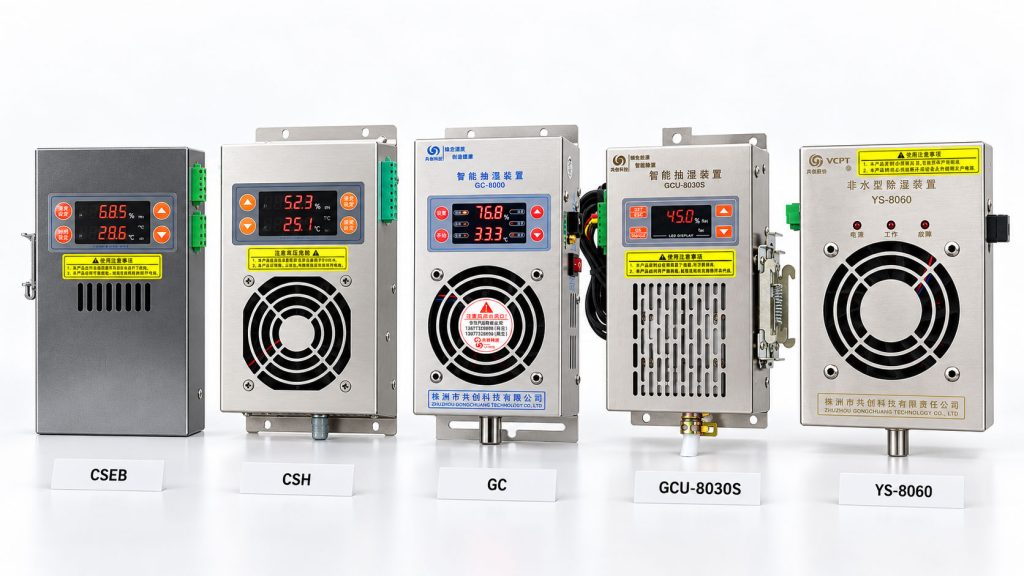
| Model | What makes it different | Typical use |
|---|---|---|
| CSEB DC Cabinet Dehumidifier | Runs on 12V, 24V, 48V DC or 220V AC; 380 mL/24h at 60W (35°C, 85% RH) | Energy storage, telecom and DC control cabinets |
| CSH Ultra-Thin DIN Rail Dehumidifier | 47 mm thick, DIN rail mounting; 588 mL/day at 60W (35°C, 85% RH) | Panels where space is already committed |
| GC Series Smart Switchgear Dehumidifier | 304 stainless housing, 15–80W options; dew-point control on T models | Substations, switchgear and ESS enclosures |
| GCU-8030S Mini Electrical Cabinet Dehumidifier | 45 mm thick, 35 mm DIN rail or bracket, RS485 available | Small distribution and control boxes |
| YS-8060 Anti-Condensation Drain Dehumidifier | Continuous drainage through a silicone hose, status indicator lights | Cabinets where condensate must leave the enclosure |
All series include automatic defrost, and an optional output can switch an external heater at low temperatures. For enclosures of 5–10 m³, ask us about our compact compressor models. You can browse the full range on our products page.
Size a Cabinet Dehumidifier for Your Enclosure
Send us the enclosure dimensions, the ambient temperature and humidity, whether a drain path is available, and your power supply. We will recommend a model, explain where the water goes, and give you capacity at your conditions rather than ours. Learn more about Gongchuang as an industrial dehumidifier manufacturer, or contact our engineers.
Frequently Asked Questions
How do dehumidifiers work in simple terms?
Every dehumidifier takes one of three routes. It condenses water on a surface colder than the air’s dew point (refrigerant and thermoelectric units), captures water on a desiccant such as silica gel and then drives it off with heat (desiccant units), or keeps humid air out by purging an enclosure with dry air (membrane dryers, positive-pressure purge and vortex coolers). Removing water this way always releases about 2,450 kJ of latent heat per kilogram.
What is the difference between a refrigerant and a desiccant dehumidifier?
A refrigerant dehumidifier cools air below its dew point on a coil, which is efficient in warm, humid air but loses capacity and frosts in cold conditions. A desiccant dehumidifier adsorbs water onto a material and regenerates it with hot air, so it keeps working in the cold and reaches much lower dew points, at the cost of regeneration heat. Below a target dew point of roughly 40°F (4–5°C), desiccant systems usually become the practical choice.
Why does my dehumidifier blow warm air?
Turning water vapour into liquid releases latent heat, about 2,450 kJ per kilogram of water. A refrigerant dehumidifier returns that heat, plus the compressor’s work, to the air through its condenser coil, so the air leaving it is drier and slightly warmer. That is physics, not a fault.
How do dehumidifier work cycles change in cold weather?
A refrigerant or thermoelectric unit depends on a cold surface below the dew point. In cold air there is less water to remove and the coil runs close to freezing, so capacity falls and the unit spends time in defrost cycles. For cold spaces or very low dew points, desiccant equipment is usually the better fit.
What does pints per day actually mean?
Pints per day is water removal at one set of test conditions. Since June 2019, US portable dehumidifiers have been tested at 65°F instead of 80°F, and ENERGY STAR notes that a unit once rated at 50 pints/day is now rated at about 30. Always ask for capacity at your own temperature and humidity.
Do dehumidifiers work inside sealed electrical cabinets?
Yes, but at a different scale. A room dehumidifier cannot dry the inside of a closed cabinet. Compact condensing cabinet dehumidifiers remove the water and drain it out; where instrument air is available, dry-air purge systems keep humid air from entering. An IP66 or NEMA 4X rating does not stop a cabinet from breathing in moist air as it heats and cools.
References
- ENERGY STAR, “Dehumidifier Testing and Capacity” (2019 DOE test procedure change and capacity re-ratings).
- Appliance Standards Awareness Project, “New dehumidifier standards will help dry up excess energy use” (65°F test temperature).
- Latent heat of vaporisation of water at 20°C: about 2,454 kJ/kg (standard steam tables).
- Gongchuang product data sheets: CSH, CSEB, GC, GCU and YS series.